
Smog Check: What Every Driver Needs to Know
California requires a smog check for most vehicles every two years — and if you've ever missed the deadline, you know the DMV won't let you renew your registration until you pass one. It's one of those things that feels like a hassle until you understand what it actually does and how easy it is to get done.
This guide covers everything you need to know: what a smog check tests, which vehicles need one, how often, what it costs, and how to make sure you pass the first time.
What Is a Smog Check?
A smog check is an emissions inspection that measures the pollutants your vehicle releases into the air. Technicians connect diagnostic equipment to your car and test the exhaust output against state-mandated limits. If your vehicle's emissions fall within the acceptable range, you pass. If not, you'll need repairs before you can register.
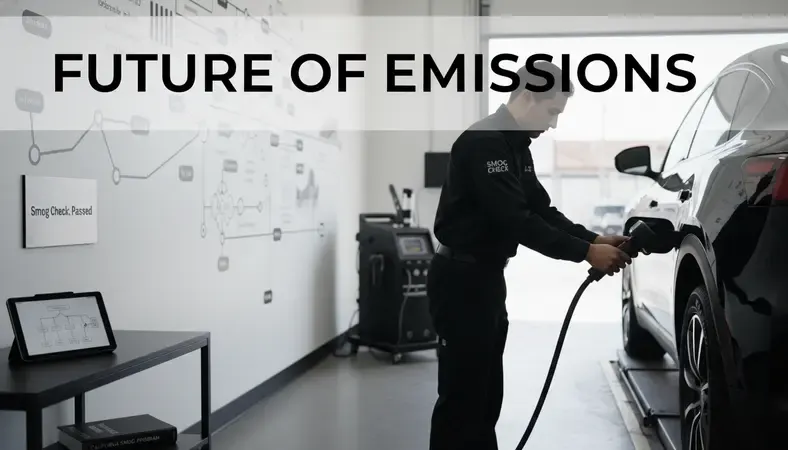
California's smog check program is administered by the Bureau of Automotive Repair (BAR), a state agency under the Department of Consumer Affairs. The program has been running since 1984 and is one of the most rigorous vehicle emissions testing programs in the United States.
The test itself typically takes 15 to 30 minutes. A STAR-certified station — the highest certification level in California — can handle both standard and directed inspections, including vehicles flagged by the DMV for enhanced testing.
Key Insight: California's smog check program has helped reduce vehicle-related smog-forming emissions by more than 80% since its launch, according to the California Air Resources Board (CARB).
Why Do I Need a Smog Check?
The short answer: it's the law in California, and you can't renew your vehicle registration without a passing smog certificate.
But there's a bigger picture here. Vehicle exhaust is a primary source of air pollution in urban areas. Nitrogen oxides (NOx) and hydrocarbons from cars react with sunlight to form ground-level ozone — the brown haze you see hanging over the Bay Area on hot days. That ozone causes respiratory problems, especially for children, the elderly, and people with asthma.
A smog check catches vehicles that are emitting far more pollutants than they should. A single malfunctioning vehicle can produce as much pollution as dozens of properly maintained cars. Regular testing ensures those vehicles get fixed before they do more damage.
For you personally, a failing smog check is also an early warning sign. If your car is producing excessive emissions, something is wrong — a faulty oxygen sensor, a bad catalytic converter, an EGR valve issue. Catching that early usually means a cheaper repair than waiting until the problem gets worse.
How Often Is a Smog Check Required?
For most vehicles in California, a smog check is required every two years, aligned with your vehicle registration renewal cycle.
There are a few exceptions worth knowing:
- New vehicles: Cars less than eight model years old are exempt from the biennial smog check requirement in California. So a 2022 model year vehicle won't need its first smog check until 2030 (or when it's sold, whichever comes first).
- Diesel vehicles: Diesel-powered vehicles 1998 and newer with a gross vehicle weight rating (GVWR) of 14,000 lbs or less require a smog check.
- Change of ownership: If you're buying or selling a vehicle, a smog check is typically required at the point of sale, regardless of when the last inspection occurred.
- Moving to California: If you're bringing a vehicle from out of state, you'll need a smog check before you can register it in California.
The DMV will notify you when your smog check is due as part of your registration renewal notice. Don't ignore it — driving with an expired registration is a ticketable offense.
What Vehicles Need a Smog Check?
Not every vehicle on the road requires a smog check. Here's a breakdown of what's required and what's exempt.
Smog Check Requirements by Vehicle Type
| Vehicle Type | Requirement | Notes |
|---|---|---|
| Gasoline vehicles (1976+) | Required every 2 years | Standard biennial inspection |
| Diesel vehicles (1998+, ≤14,000 lbs) | Required every 2 years | Must be tested at diesel-capable station |
| Hybrid vehicles | Required every 2 years | Treated same as gasoline vehicles |
| Electric vehicles (EVs) | Exempt | No tailpipe emissions |
| Motorcycles | Exempt | Not included in the program |
| Vehicles 8 model years or newer | Exempt | Covered by manufacturer warranty |
| Pre-1976 vehicles | Exempt | Too old for the program's equipment |
| Farm equipment/off-highway vehicles | Exempt | Not registered for road use |
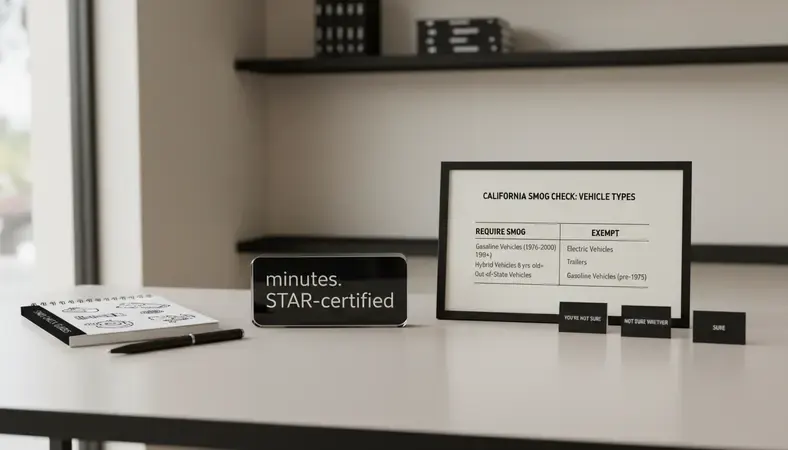
If you're not sure whether your specific vehicle needs a smog check, the California DMV's website lets you look up your registration status by license plate number.
How to Pass a Smog Check
Most vehicles in good working order pass without any issues. The smog check isn't designed to be a trap — it's measuring whether your car is operating the way it's supposed to.
Here's what actually gets tested and what you can do to give yourself the best shot at passing:
What the Test Measures
-
OBD-II system scan: For vehicles 2000 and newer, the technician plugs into your car's onboard diagnostic port. The system checks for any stored fault codes (those are the "check engine light" triggers). If your check engine light is on, you will not pass — period.
-
Visual inspection: The technician checks that required emissions components are present and haven't been tampered with. This includes the catalytic converter, EGR valve, and fuel cap.
-
Functional inspection: Components like the gas cap are tested to ensure they're sealing properly. A faulty gas cap can cause evaporative emissions failures.
-
Tailpipe emissions test (older vehicles): For pre-2000 vehicles, exhaust gases are measured directly using a probe inserted into the tailpipe.
Tips to Improve Your Chances
- Fix that check engine light first. This is the single most common reason vehicles fail. If the light is on, get the underlying issue diagnosed and repaired before booking your smog check.
- Drive your car before the test. A cold engine doesn't run at its optimal emissions profile. Drive at highway speeds for 15 to 20 minutes before your appointment. This ensures the catalytic converter is fully warmed up and operating at peak efficiency.
- Don't get a smog check right after an oil change. Fresh oil sometimes introduces unburned hydrocarbons into the exhaust briefly. Give it a few days.
- Check your tire pressure. This sounds unrelated, but underinflated tires affect how the dynamometer reads your vehicle during load testing.
- Make sure your gas cap is tight. A loose or cracked gas cap is a quick fail on the evaporative emissions portion of the test.
If your vehicle fails, you'll receive a Vehicle Inspection Report detailing exactly what didn't pass. You can then take that to a repair shop, get the issue fixed, and return for a retest.
Where to Get a Smog Check
You have two main options: a Test-Only station or a Test-and-Repair station.
- Test-Only stations are licensed exclusively to perform smog inspections. They cannot do repairs. Because they have no financial incentive to pass or fail your car (they don't make money on repairs), many drivers prefer them for an unbiased result.
- Test-and-Repair stations can both test and fix your vehicle. Convenient if you fail and need immediate repairs, but some drivers prefer to separate the testing and repair functions.
STAR-certified stations are a subset of both types that meet higher performance standards set by the Bureau of Automotive Repair. If the DMV has specifically directed your vehicle to a STAR station (noted on your renewal notice), you must go to a STAR-certified location — a regular smog station won't satisfy the requirement.
You can find certified smog stations through the California Bureau of Automotive Repair station locator. When you're searching, filter for STAR certification if your DMV notice requires it.
If you're in the San Leandro area, Speedy Smog is a STAR-certified station that handles most vehicles in under 15 minutes. You can make an appointment in advance to avoid waiting.
How Much Does a Smog Check Cost?
Smog check pricing in California varies by station and vehicle type. Pricing is not regulated by the state, so stations set their own fees — contact individual stations for a personalized quote.
A few things that can affect what you pay:
- Vehicle type: Diesel vehicles and larger trucks sometimes cost more to test than standard passenger cars.
- STAR certification: STAR stations may charge differently than non-STAR stations.
- Retest fees: If you fail and return to the same station within a specified period, many stations offer reduced-cost retests.
- Consumer Assistance Program (CAP): If your vehicle fails and you meet income eligibility requirements, California's CAP program may provide financial assistance for repairs or a vehicle retirement incentive. The Bureau of Automotive Repair administers this program.
The smog certificate fee — a state-mandated charge that goes to the BAR — is separate from the station's testing fee and is collected at the time of inspection.
Common Questions About Smog Checks
What happens if my car fails a smog check?
You'll receive a Vehicle Inspection Report listing the specific reasons for the failure. You're not required to repair at the same station — take the report to any licensed repair shop. Once repairs are complete, you return for a retest. If your vehicle continues to fail and repair costs are high, California's Consumer Assistance Program may provide financial help or a retirement option for older vehicles.
Can I drive my car if it fails a smog check?
Yes, a failed smog check doesn't make your car illegal to drive immediately. You can still operate the vehicle. The issue is that you won't be able to renew your registration until you pass. Driving with an expired registration is a separate violation.
How long is a smog certificate valid?
A California smog certificate is valid for 90 days from the date of the inspection. If you don't complete your registration renewal within that window, you may need to get another smog check.
Do I need a smog check if I just bought a used car?
If the seller provided a smog certificate issued within 90 days of the sale date, you're covered. If not, you'll need to get a smog check before you can register the vehicle in your name. The responsibility for providing a valid smog certificate at the point of sale falls on the seller.
What is a STAR-certified smog station?
STAR is the Bureau of Automotive Repair's highest certification level for smog stations. STAR stations are required to meet stricter performance and equipment standards than regular smog stations. If the DMV's renewal notice specifically states your vehicle must be tested at a STAR station, only a STAR-certified location will satisfy that requirement.
Does a smog check test everything about my car's health?
No. A smog check is specifically an emissions test — it measures what your vehicle is releasing into the air. It doesn't check brakes, tires, suspension, lights, or other mechanical systems. Think of it as one specific piece of your car's overall maintenance picture, not a comprehensive safety inspection.
Wrapping Up
A smog check is straightforward when your vehicle is properly maintained. Fix any check engine lights before your appointment, warm up the engine beforehand, and you'll likely be in and out in under 20 minutes.
Book your smog check at Speedy Smog in San Leandro — STAR certified, most vehicles done in under 15 minutes, open 6 days a week. Call (510) 614-7664 to schedule or visit speedysmogchecksanleandro.com to make an appointment.