
DMV Smog Test Only: What It Means and Where to Go
A DMV smog test only station performs the emissions inspection but cannot perform repairs, so a failed vehicle must go elsewhere for diagnosis and fixes. California had 8,213 licensed Smog Check stations in December 2018, including 4,225 STAR stations, and STAR locations handled 82% of approximately 11.4 million initial tests that year (California Bureau of Automotive Repair performance report).
You may be looking at a renewal notice, searching for “dmv smog test only,” and wondering whether the first station you find can also repair your car if something goes wrong. That uncertainty matters. The right choice depends on what the DMV notice says, whether your vehicle appears ready for testing, and whether you need only a certification or also expect emissions repairs.
A test-only visit can be straightforward when your vehicle is prepared and the DMV needs a valid result. It can also become an unnecessary second trip if your car has a warning light, incomplete readiness monitors, or a known emissions problem. The station type is part of the decision, not just a label on a sign.
Table of Contents
- Understanding DMV Smog Test Only Stations
- The STAR Certification Ecosystem and What the Numbers Reveal
- Comparing Test Only Stations and Full Service Repair Stations
- What to Expect at a STAR Certified Test Only Location
- Why Test Readiness Matters More Than Test Speed
- Making the Right Choice for Your Vehicle Situation
Understanding DMV Smog Test Only Stations
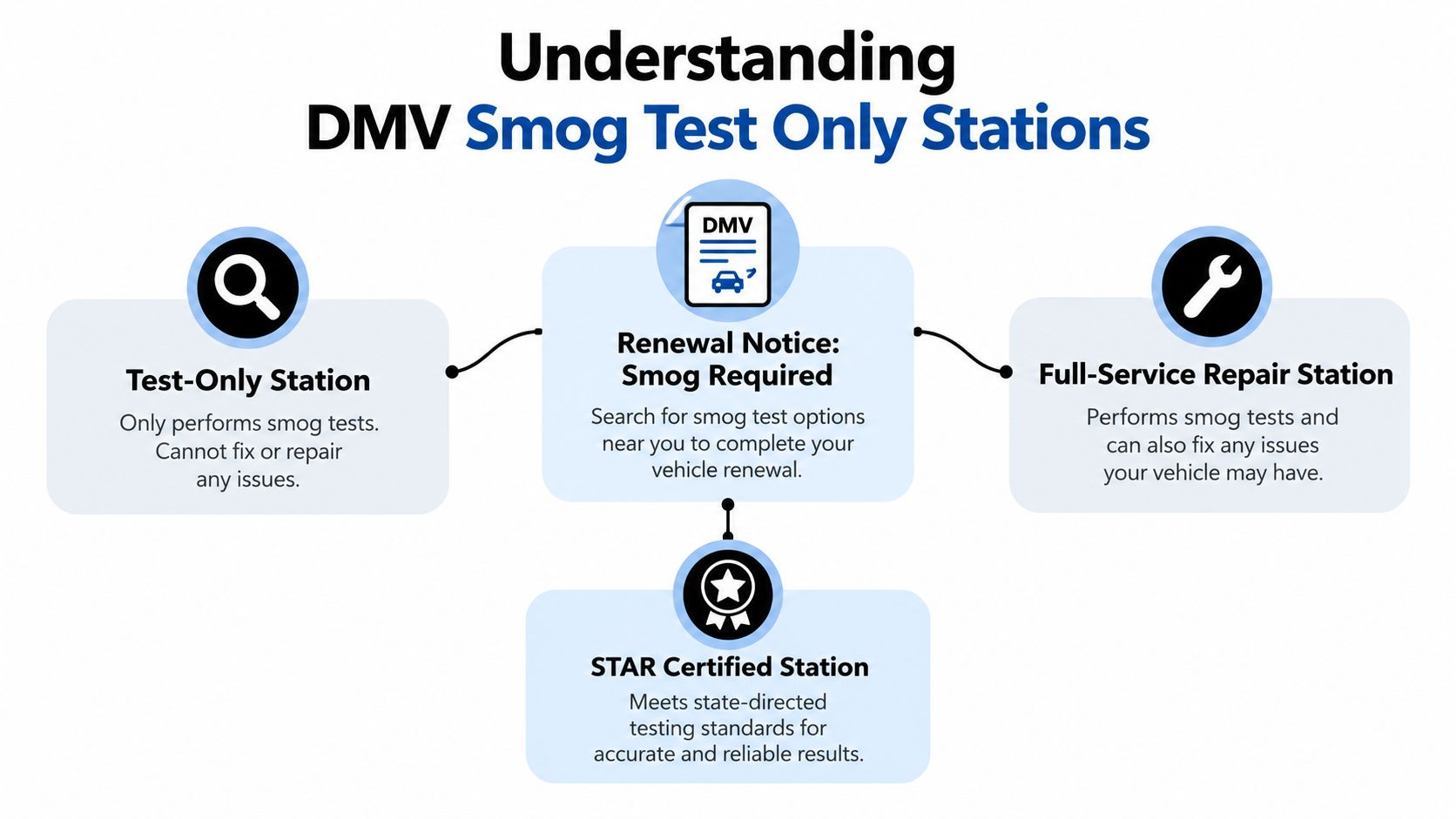
A DMV renewal notice arrives, the word “smog” catches your eye, and you start comparing nearby shops. One advertises testing only. Another offers testing and repairs. The difference is simple but important: a DMV smog test only station is authorized to inspect your vehicle, not repair its emissions system.
Think of the station as a medical testing office. It can examine the patient, run the required checks, and report the result, but it doesn't provide the treatment. If your vehicle fails, you'll receive information about the failure and then need a qualified repair facility for diagnosis or correction.
What the inspection includes
California's Smog Check inspection can involve several parts:
- Visual examination: The technician checks emissions-control hardware for missing, disconnected, or visibly altered components.
- Functional checks: The station verifies that required systems operate as expected.
- Computer testing: On most model-year 2000 and newer vehicles, an OBD test reads emissions-related data from the vehicle computer.
- Tailpipe testing: Pre-2000 vehicles generally receive a tailpipe emissions test instead.
The California Bureau of Automotive Repair describes the inspection process and vehicle testing pathways in its Smog Check guidance. An OBD-equipped car can fail even when it feels normal if the malfunction indicator lamp is illuminated or the computer reports an emissions issue.
Why the distinction affects your next move
A test-only station suits a driver who needs a certification and expects the vehicle to pass. It may be less convenient if you've already diagnosed an emissions fault and want one business to test, repair, and retest the car.
Before booking, check whether the DMV notice directs you to a STAR station. If it doesn't, you can generally compare station type, location, availability, and service scope. For a more detailed explanation of the test-only model, see this guide to what a test-only smog station does.
Practical rule: Choose a test-only station for an inspection. Choose a repair-capable station when you already need emissions diagnosis or correction.
The STAR Certification Ecosystem and What the Numbers Reveal
A lot of frustration around smog checks comes from treating every station like it does the same job. The network is more like a road system with different lanes. Some stations can handle standard inspections. Some can also handle vehicles the state wants reviewed under tighter rules.
That is where STAR fits. The Bureau of Automotive Repair uses the STAR Program to identify stations that meet added performance requirements and can inspect vehicles assigned for enhanced scrutiny. If your renewal notice points you to a STAR location, the station type is part of the transaction, not a small technical detail.
The scale of that role becomes clearer when you look at inspection volume instead of repeating station totals. In 2018, California conducted about 11.4 million initial Smog Check tests. STAR stations performed about 9.3 million, or 82%, while non-STAR stations performed roughly 2.1 million, or 18%, according to BAR's 2019 performance report.
Those numbers help explain the system. A station category can represent only part of the network on paper and still carry most of the day-to-day workload. For drivers, that means STAR is not a rare label you can ignore. It is a major part of how vehicles move through California's registration process.
The second confusion point is what STAR does not mean. STAR certification does not mean your car is more likely to pass. It also does not automatically tell you whether the shop repairs vehicles. The label speaks to the station's standing in the regulatory system. Your vehicle still has to satisfy the inspection requirements, and the business may be test-only or may also offer repairs.
A simple way to sort this out is to start with the notice in your hand.
- Read the DMV notice first: it may name the station category you need.
- Treat a STAR direction as a requirement: a nearby non-STAR shop may not complete the inspection the DMV expects.
- Separate certification from service model: a STAR station can be test-only, or it can also perform repairs.
- Use station type as a planning tool: it helps you choose a shop that matches your registration step, not just the closest address.
If you want a plain-language overview before booking, this explanation of what a STAR station is can help clarify the label.
Comparing Test Only Stations and Full Service Repair Stations
The best station depends on what you need after the technician connects the equipment. If your goal is a DMV certificate and your vehicle appears healthy, a test-only location may provide the cleanest path. If you expect a failure or already know about an emissions fault, a repair-capable shop may reduce the number of separate visits.
| Criterion | Test-Only Station | Full-Service Station |
|---|---|---|
| Inspection scope | Performs the required smog inspection and reports the result | Performs the inspection and may diagnose or repair emissions problems |
| After a failure | Provides the test result, but repairs must happen elsewhere | May diagnose and correct the issue on site |
| Convenience | Efficient when you only need certification | More convenient when testing and repair belong in the same visit |
| Best fit | A prepared vehicle needing a DMV result | A vehicle with a known or suspected emissions problem |
Speed
Test-only facilities focus their workflow on inspection. That specialization can be useful when your vehicle is ready and you don't need troubleshooting. A shorter visit doesn't necessarily mean a better outcome, though. Testing an unready vehicle quickly still produces an inconvenient result.
Scope
A full-service repair station combines two jobs. The technician can inspect the vehicle, identify a likely cause of failure, and potentially perform the necessary work. That broader scope matters when the check engine light is on, an emissions component is missing, or a prior diagnostic scan identified a fault.
A test-only station isn't withholding a service by refusing to repair. Its authorization and business model focus on independent inspection. You'll need to treat the result as a decision point, then take the vehicle to a repair professional if necessary.
Cost
Prices vary by station, vehicle, and service arrangement. A test-only visit may involve only the inspection, while a full-service visit can lead to diagnostic and repair charges if the vehicle fails. Ask what the quoted price covers before authorizing work, especially if you're choosing a repair-capable shop because you expect a problem.
Appropriateness
Use this quick filter:
- Choose test-only when the DMV requires certification and you have no reason to suspect an emissions fault.
- Choose full-service when a warning light is active, readiness is incomplete, or a technician has already identified a likely emissions problem.
- Confirm STAR status when the DMV or BAR directs your vehicle to a STAR facility.
- Plan for a separate repair visit if you use test-only and the vehicle doesn't pass.
The important question isn't “Which station is always best?” It's “What does my vehicle need before the DMV can accept the result?”
What to Expect at a STAR Certified Test Only Location
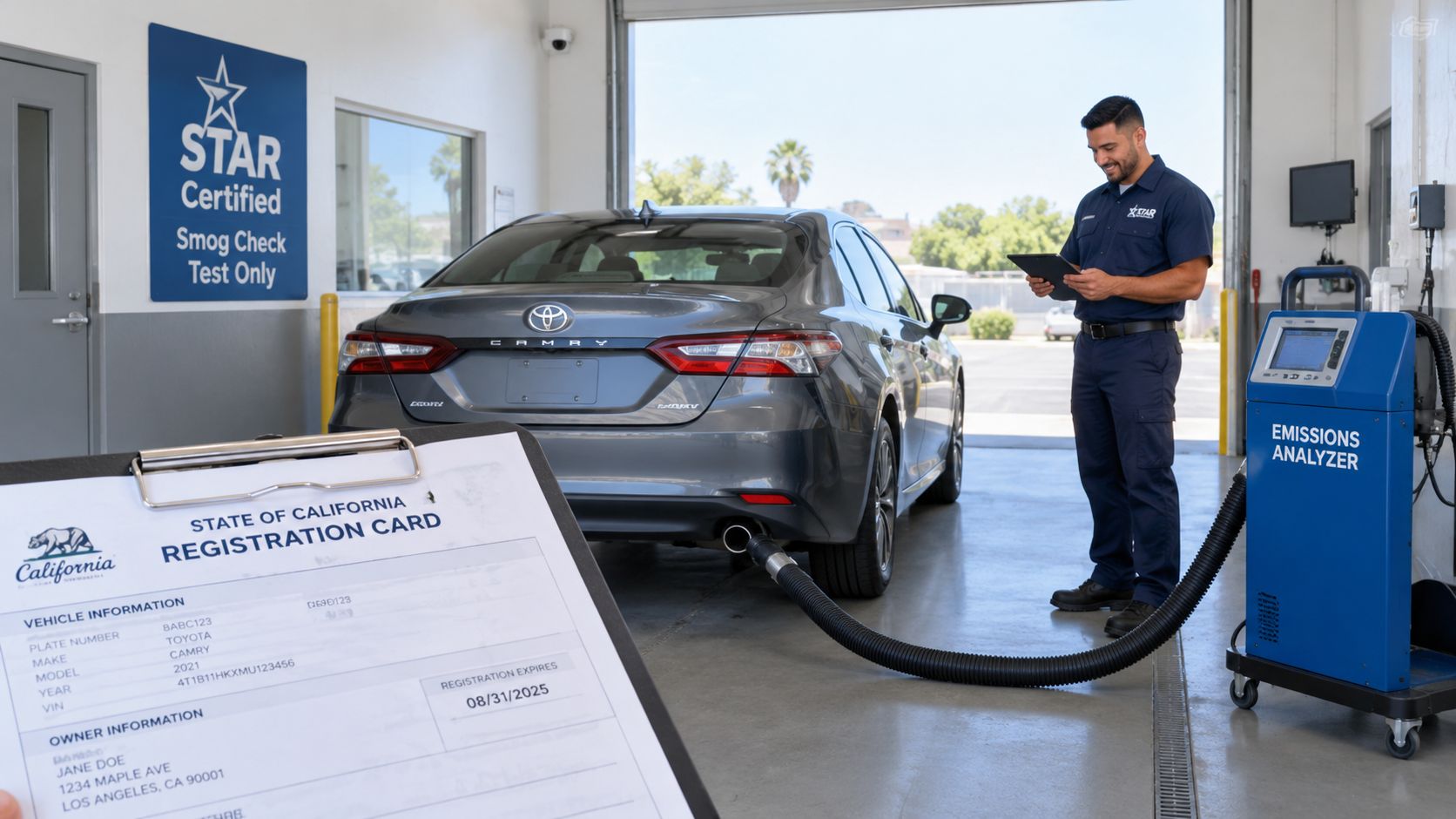
At a STAR-certified test-only location such as Speedy Smog in San Leandro, the visit follows a defined inspection process. The facility is at 15275 Washington Avenue, and its role is to perform the test and transmit the result, not repair emissions faults.
Bring the vehicle and the registration information connected with the DMV transaction. The technician begins by checking the emissions-control equipment, then performs the appropriate functional and computer-based inspection for the vehicle.
The visit from arrival to result
For most 2000 and newer vehicles, the technician connects to the OBD system and reads emissions-monitoring information. The process also includes a visual review of relevant hardware. Older vehicles generally follow the applicable tailpipe testing pathway.
A STAR-certified location can handle a DMV-directed inspection when the vehicle's paperwork requires that category. The certification relates to the station's authorization and performance standards. It doesn't remove the vehicle's responsibility to meet the inspection criteria.
The result is transmitted electronically to the DMV when the transaction calls for electronic reporting. If the vehicle passes, that result supports the registration process. If it fails, the station provides the failure information, but you'll need to arrange repairs somewhere else before seeking another test.
What a failed result means
A failure isn't proof that the station performed the wrong kind of test. It means the vehicle didn't satisfy one or more inspection requirements at that visit. The next step might involve diagnosis, a repair, additional driving to restore monitor readiness, or a combination of these.
Don't authorize repairs based only on a vague assumption. Ask for the specific failure information, then use a qualified repair facility that can interpret emissions codes and test the affected system. A test-only business can identify the result without creating a repair plan on site.
Why Test Readiness Matters More Than Test Speed
You find an open smog appointment for this afternoon, drive over, and expect to be done in twenty minutes. Then the test stops on a detail you cannot see from the driver's seat. The engine feels fine, but the car's computer is still "not ready."
That is why station speed is only one part of the decision. A test-only visit works like a checkpoint, not a repair bay. If the vehicle has not completed its own emissions self-checks, the fastest line in town does not change the result.
BAR data shows emissions problems are common enough that preparation matters. California's 2024–25 roadside inspection failure rate was reported at 14% (BAR report). That number does not measure station Smog Check results directly, but it does show that out-of-compliance vehicles are not rare.
OBD readiness monitors work like a checklist the car fills out on its own while you drive. Each monitor confirms that an emissions-related system has run its self-test. If you disconnect the battery or clear trouble codes, parts of that checklist can reset to incomplete. The car may drive normally, yet still lack the information needed for a complete inspection.
Common readiness traps
- Battery replacement: Disconnecting the battery can erase stored readiness status.
- Code clearing: Clearing a diagnostic code can hide the symptom for the moment without fixing the cause.
- Recent repairs: A successful repair can still leave monitors incomplete until the vehicle is driven enough.
- Warning-light concerns: A malfunction indicator lamp can point to an emissions problem that should be diagnosed first.
BAR's owner guidance advises against clearing trouble codes or disconnecting the battery immediately before testing, because those actions can erase readiness monitors and may require additional driving.
A vehicle that isn't ready can't be made ready by a shorter queue.
Schedule diagnosis before the smog test if the check engine light is on, the battery was recently disconnected, or a scan tool shows incomplete monitors. That extra step often saves time overall. Otherwise, a quick appointment can turn into a failed visit, a repair appointment, more driving, and a retest. Before you shop for speed, get the vehicle ready.
Making the Right Choice for Your Vehicle Situation
Station selection becomes easier when you treat it as a decision tree rather than a search for the fastest appointment. Start with the DMV transaction. A routine renewal, an initial California registration for an out-of-state vehicle, and an ownership-related transaction can create different requirements, so follow the exact notice and DMV instructions connected with your vehicle.
California's DMV guidance explains that many registration transactions require inspections, while some vehicles and situations are exempt. Gasoline vehicles less than eight model-years old are generally exempt from biennial testing, electric vehicles are exempt entirely, and hybrid vehicles can still fall within the Smog Check program (California DMV smog inspection guidance). Diesel rules also depend on model year and vehicle weight, so don't rely on a blanket assumption.
Four questions to ask before booking
- Does the DMV require a smog result? Check the renewal notice or registration instructions rather than assuming every transaction follows the same rule.
- Does the notice require STAR? If the vehicle is directed to a STAR station, select a location with that certification.
- Is the vehicle ready? Consider recent battery work, cleared codes, repairs, or an active warning light.
- Do you need repairs as well as testing? A test-only station handles the inspection. A repair-capable shop may be more suitable when you already suspect a fault.
For drivers comparing nearby options, this guide to where to get a car emissions test can help organize the choice.
Match the station to the situation
A prepared vehicle that only needs certification is a natural fit for a test-only station. A vehicle with a known emissions problem belongs with a repair-capable provider, unless you deliberately want an independent test before authorizing any work.
Hybrid owners should pay attention to the same warning lights and readiness issues as gasoline-vehicle owners. Electric propulsion doesn't automatically mean a hybrid is exempt, and the applicable rules depend on the vehicle type and transaction.
The most useful question isn't “How quickly can I get tested?” It's “What result do I need, and what will I do if the result is incomplete or unsuccessful?” Answer that first, then choose the station.
Speedy Smog is a STAR-certified, test-only station in San Leandro that performs DMV smog inspections for vehicles including newer cars, older vehicles, diesels, and hybrids, with electronic result transmission for registration purposes. Visit Speedy Smog at 15275 Washington Avenue when you need a focused inspection and understand that repairs after a failure must be handled by a separate repair provider.