
STAR Certified Smog Check Price: What to Expect
A STAR certified smog check in California typically runs $50 to $90 total at the counter. The $8.25 certificate fee is fixed by the state, while the rest of the bill is set by the station.
You're probably asking because a registration notice, DMV renewal, or vehicle sale has put a deadline in front of you. You call one shop and hear a low advertised price. Another shop quotes more. Then someone mentions that your vehicle must visit a STAR station, and the whole process starts sounding more expensive than it should.
As a San Leandro shop owner, I've seen the same confusion for years. Drivers often treat STAR as a premium brand or assume the state controls the entire bill. It doesn't. The certificate fee is regulated. The inspection price is not. Your vehicle's year, fuel type, inspection category, and the station's own pricing policy determine the rest.
Table of Contents
- What You Actually Pay at the Counter
- Why STAR Certification Exists and How It Shapes the Inspection
- The Three Factors That Drive STAR Pricing Up or Down
- San Leandro and East Bay Pricing in Real Situations
- Hidden and Surprise Charges Worth Watching For
- Discounts, Coupons, and Smart Ways to Lower the Final Bill
What You Actually Pay at the Counter
Standing at the counter, ask for one number: the total amount due if the vehicle passes. Don't settle for an advertised starting price until the employee explains what that price includes.
The California Bureau of Automotive Repair states that the Smog Check certificate fee is fixed at $8.25, and a station must charge it when the vehicle passes inspection. BAR also says inspection prices themselves aren't regulated, so each station can set its own charge. That distinction is the foundation of the California smog check price guide.
The station's charge pays for the actual inspection service. Depending on the vehicle, that can include the visual emissions inspection, an OBD system check, required emissions testing, technician labor, and electronic reporting. The $8.25 certificate fee doesn't pay for the technician's time or the equipment used to inspect your car. It pays for the state certificate attached to a passing result.
BAR's statewide reporting shows why the final bill usually sits far above the certificate fee. In one 2026 reporting period, STAR Test-and-Repair inspections averaged $77.93, while STAR Test Only inspections averaged $66.70. BAR's 2025 summary listed a STAR Test-and-Repair inspection-only average of $75.79 and an overall average of $69.22 when transactions were combined. Those figures cover the market-driven inspection portion and demonstrate how much more the station charge can be than the certificate itself. (California BAR Smog Check information)
| Cost Component | Amount | Who Sets It | What It Covers |
|---|---|---|---|
| State certificate fee | $8.25 | California BAR | The certificate issued after a passing inspection |
| Station inspection charge | Varies by station and vehicle | The station | Inspection labor, equipment, and required testing |
| Optional transaction charges | Varies | The station, subject to applicable rules | Possible electronic transmission or related service charges |
| Final customer bill | Commonly falls in the $50 to $90 range | The combined pricing structure | The complete amount paid at the counter |
Practical rule: Ask, “What is my total price, including the certificate fee and every required charge, if the car passes?”
A reputable shop should answer before starting the inspection. If the employee only repeats “starting at” pricing, ask what changes the price for your exact vehicle. That question usually tells you more than the STAR label on the sign.
Why STAR Certification Exists and How It Shapes the Inspection
STAR certification isn't a premium inspection brand. It's a performance-based designation created by the California Bureau of Automotive Repair for qualifying Test Only and Test-and-Repair stations.
BAR ties the designation to measurable performance requirements. A station seeking STAR certification must meet thresholds that include a Similar Vehicle Failure Rate of at least 50% of the industry-wide failure rate for similar vehicles, a Gear Shift Incident rate no greater than 2%, and an Excessive Test Deviation Rate of no more than one. BAR also requires a Follow-up Pass Rate score of at least 0.40 before a station becomes eligible. (BAR STAR certification requirements)
Those figures matter because they show what STAR is designed to control. The program evaluates whether a station performs inspections consistently and identifies vehicles that need attention. It doesn't create a separate retail price schedule, and it doesn't mean every STAR station charges the same amount.
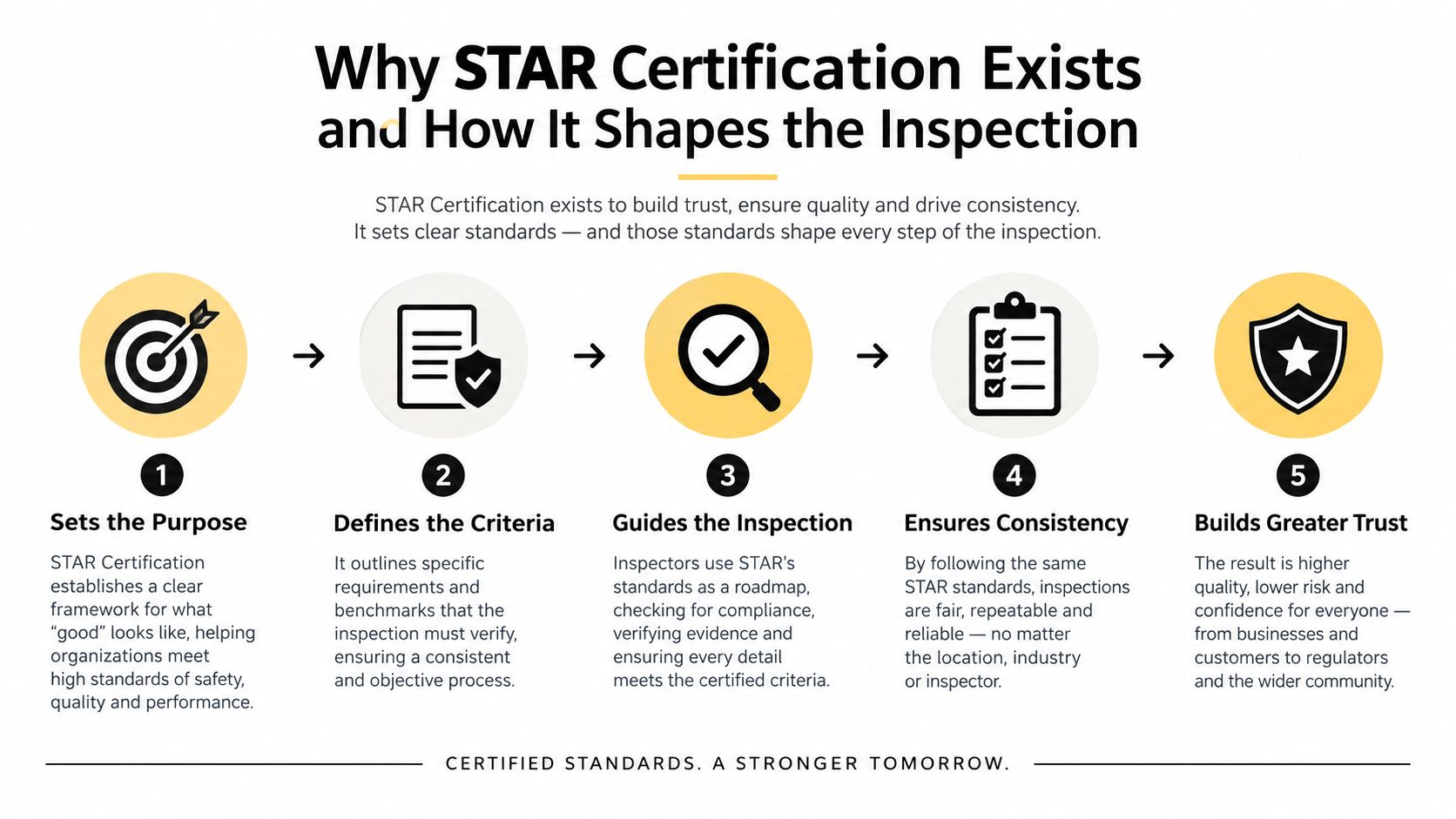
Some vehicles are directed to STAR stations by the DMV or BAR because they need a compliance-sensitive inspection. In that situation, STAR isn't optional. The station must be approved for the required inspection category, and the driver should follow the instructions on the notice rather than choosing a cheaper station that can't issue the needed certificate.
What changes for the driver
The core testing steps will look familiar. A technician still checks the vehicle's emissions equipment and runs the required computerized or emissions test. STAR adds a stricter oversight framework around the station's work, not a mysterious new type of engine test.
That's why I tell customers to separate inspection quality from retail price. A STAR station can charge a reasonable market price, but the designation itself doesn't guarantee a discount. Before booking, confirm that the station accepts your vehicle's inspection requirement and ask for the out-the-door price.
For a plain-language explanation of the designation, see what a STAR smog station does. The most useful question isn't “Is STAR more expensive?” It's “What does this station charge for my vehicle and inspection type?”
The Three Factors That Drive STAR Pricing Up or Down
A STAR badge does not set one flat price. At the counter, the total usually comes from three separate factors: vehicle age, vehicle type, and station classification. The state certificate fee is regulated, while the station's inspection charge is not. Your vehicle and the required test determine whether the STAR premium is justified or mostly a marketing label.
Vehicle year affects the work involved
Newer gasoline vehicles commonly receive an OBD-based inspection. Older vehicles may require a more involved process, with different equipment, procedures, and technician time. Those differences can raise the station's charge even when the required certificate is the same.
For newer vehicles, independent listings show some stations advertising $40 to $70. The advertised amount may include the certificate fee, or it may leave that state charge out. Ask for the complete total before booking, including the $8.25 certificate fee. Example STAR station pricing information
A low advertised price is useful only when you know what it covers.
Fuel type changes the quote
Diesel vehicles should not be priced from a gasoline-car advertisement. Diesel inspection requirements and equipment can differ, so call with the fuel type, model year, and vehicle classification before driving to the station. A gasoline promotion may exclude diesel testing.
The same rule applies to hybrids. A hybrid may use an OBD-based inspection, but the station must confirm that it can perform the required test for that vehicle. Ask whether the quoted price covers the exact vehicle and inspection category rather than assuming a standard gasoline offer applies.
Station classification matters
BAR reporting separates STAR Test Only stations from STAR Test-and-Repair stations. In the cited 2026 report, STAR Test Only averaged $62.36, with a $50.86 25th percentile and a $58.06 median. BAR cautions that reported customer-paid costs may include discounts and may not represent the full inspection cost, so a coupon can change the final bill. (BAR March 2026 executive summary)
| Cost Driver | Low-End Price | High-End Price | Why It Changes |
|---|---|---|---|
| Newer gasoline vehicle | Advertised listings commonly $40 to $70 | Station-specific; confirm whether the $8.25 certificate fee is included | OBD-based testing can be priced differently from older testing |
| Older gasoline vehicle | Varies | Varies | Equipment, labor, and inspection procedure can differ |
| Diesel vehicle | Quote required | Quote required | Fuel type and inspection requirements affect station workload |
| STAR Test Only | BAR-reported median of $58.06 | BAR-reported average of $62.36 | Test Only stations perform inspections without repair work |
| STAR Test-and-Repair | BAR-reported statewide averages above Test Only in the cited periods | Varies by station | Station category and transaction mix affect pricing |
Give the station the full vehicle details first. That means fuel type, model year, vehicle classification, and whether the DMV directed the inspection. A firm quote that ignores those details is incomplete. Ask for the out-the-door price and confirm that the regulated certificate fee is included.
San Leandro and East Bay Pricing in Real Situations
Customers often want a city-by-city price map. The East Bay doesn't work that neatly. San Leandro, Oakland, Hayward, Fremont, and nearby communities have independent stations with different equipment, workloads, coupons, and inspection categories. A station a few miles away may charge more or less for reasons unrelated to the city name.
Consider two appointment types without pretending that either has a guaranteed price.
A newer gasoline hybrid arriving with a routine renewal usually belongs in the more straightforward OBD-based conversation. The driver should ask whether the station's advertised price includes the $8.25 certificate fee, whether any discount applies, and whether the vehicle has a special DMV direction. A STAR requirement may come from the vehicle's registration situation, not from the car being costly to inspect.
A much older diesel truck is a different appointment. The driver should provide the model year, fuel type, and vehicle classification before arriving. The station may need different equipment or procedures, and a gasoline-car promotion may not apply. The correct price is the one quoted for that exact truck, not the price printed for a standard newer vehicle.
| Vehicle Type | San Leandro | Oakland or Hayward | Fremont | Walnut Creek |
|---|---|---|---|---|
| Newer gasoline vehicle | Ask for a total including the certificate fee | Compare the complete quote | Compare the complete quote | Compare the complete quote |
| Hybrid | Confirm STAR eligibility and applicable offer | Confirm vehicle-specific pricing | Confirm vehicle-specific pricing | Confirm vehicle-specific pricing |
| Older gasoline vehicle | Expect a vehicle-specific quote | Expect a vehicle-specific quote | Expect a vehicle-specific quote | Expect a vehicle-specific quote |
| Diesel vehicle or truck | Call before arrival | Call before arrival | Call before arrival | Call before arrival |
The BAR data gives a better anchor than neighborhood folklore. STAR Test Only pricing in the March 2026 report ranged from the reported 25th percentile of $50.86 to the statewide average of $62.36, with discounts potentially affecting the customer-paid amount. That spread exists inside the STAR category itself.
A cheap advertised price is useful only when you know whether it includes the certificate fee and applies to your vehicle.
Map your own situation using three facts: vehicle year, fuel type, and inspection category. Then request the full total from two or three stations. That process is more reliable than assuming every East Bay location follows the same price sheet.
Hidden and Surprise Charges Worth Watching For
The most common misunderstanding starts with the certificate fee. Some drivers see a low inspection price and assume the state charge is included. Others see $8.25 added at the bottom and think the station invented it. BAR says the certificate fee is fixed and must be charged when the vehicle passes. The station's inspection price is separate and unregulated.
Electronic transmission or transaction charges may also appear. BAR's pricing information notes that additional electronic transmission fees can affect the final bill, but the amount isn't a statewide fixed figure in the verified data. Ask whether the quoted total includes every required electronic reporting charge.
Ask about these items before authorization
- Certificate fee: Ask, “Is the $8.25 state certificate fee already included in the quoted total?”
- Electronic transmission charge: Ask whether the station adds a separate fee for submitting the result electronically.
- Retest policy: Ask whether a failed first inspection qualifies for a reduced retest price and what conditions apply.
- VIN verification: Ask whether incomplete paperwork, an unreadable VIN, or a separate verification request creates another charge.
- Pre-inspection or diagnostic work: Ask whether the shop will charge you for checking the vehicle before performing the official inspection.
- Vehicle-specific pricing: Confirm that the price applies to your year, fuel type, hybrid system, or truck classification.
- Coupon restrictions: Ask whether the discount includes the certificate fee, applies to STAR inspections, and covers a directed vehicle.
A station can set its inspection price, but that doesn't mean every fee deserves a vague explanation. The quote should distinguish the state certificate from station services and optional work. If an employee says, “We'll know after we start,” ask what could change the price and whether you can decline additional work.
A failed inspection is another point where customers lose control of the bill. The official test result and any later repair or diagnostic work are separate decisions. Don't authorize repairs just because the vehicle failed. Ask for the failure details, the retest price, and a written repair estimate before approving anything.
The practical standard is simple: no surprise line items. If the station can't explain the charge before the inspection, choose another station.
Discounts, Coupons, and Smart Ways to Lower the Final Bill
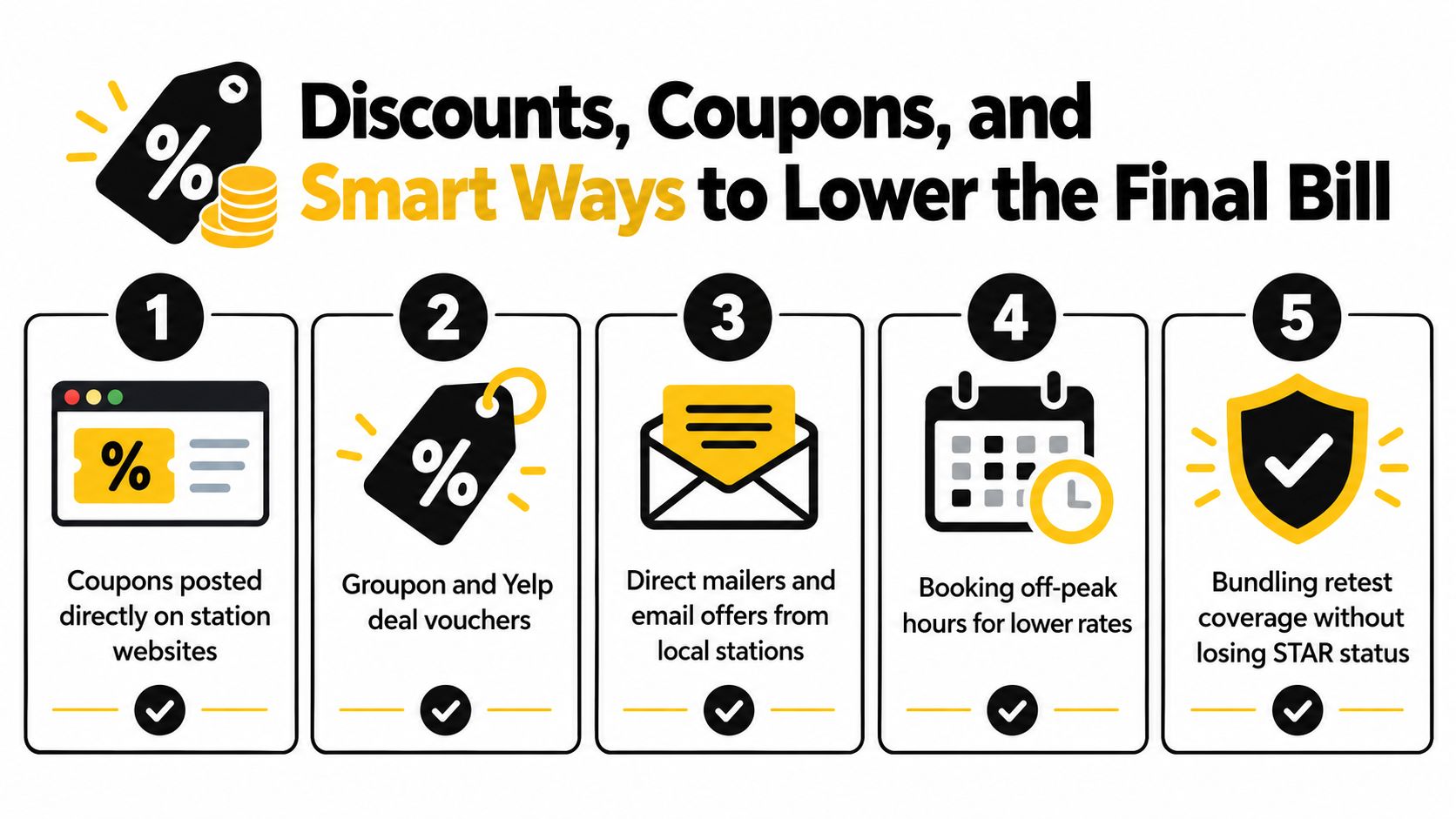
The easiest way to cut a STAR certified smog check price is to reduce the station charge, while keeping the required inspection intact. Coupons can help, and BAR notes that reported customer-paid prices may include discounts, so the number you see in a report is not always the number you will pay. Compare the final total, not the headline price.
Start with the station's own website, then check local deal pages, email offers, and direct mailers. Read every restriction before you go. Some coupons apply only to certain vehicle years or inspection types, and some separate the station charge from the certificate fee.

Use this pre-payment checklist
- Certificate fee: Is the fixed state certificate charge included?
- Transmission fee: Is electronic submission billed separately?
- Retest policy: What happens if the vehicle fails the first test?
- VIN verification: What condition triggers an extra verification charge?
- Payment timing: Do you pay before the result, or after the station completes the test?
- Failed inspection rules: Is any portion refundable if the vehicle does not pass?
- Additional diagnosis: Does the original quote stay valid if the shop recommends diagnostic work?
Compare Test Only stations with Test-and-Repair stations too. The statewide averages are different, but the cheapest category is not automatically the right choice if your DMV notice directs you to a specific STAR inspection type.
For local offers and current terms, review STAR certified smog check coupons. Bring the coupon up before the technician starts, and ask for the final total out loud. That avoids the usual billing argument, where the customer and the station are working from different definitions of “price.”
The rule is simple. Confirm the inspection category, ask for the total including $8.25, and compare two complete quotes. STAR certification can be required and worth paying for, but it is no reason to accept an unexplained premium.