
California Emissions Test Cost: A Driver’s Pricing Guide
A California emissions test costs the station's inspection price plus a flat $8.25 state certificate fee on every passing test, so there isn't one statewide sticker price. The station controls the inspection charge, while the state controls the certificate fee and collects separate DMV-related fees in different transactions.
You're probably looking at a renewal notice, calling shops, and seeing prices that don't seem comparable. One ad shows a low inspection price, another quotes a total, and a third mentions STAR certification without explaining whether it changes the fee or the testing requirement. The confusion comes from combining three different charges: the station's labor and equipment fee, the state certificate fee, and DMV registration-related fees.
I've written this the way I'd explain the bill before putting your car on the test lane. Ask for the station inspection price first, confirm whether your vehicle must use a STAR station, and then add the fixed state charge only if the vehicle passes.
Table of Contents
- What You Will Pay for a California Emissions Test
- Station Fee Versus State Fee and How They Combine
- How Vehicle Type Changes the Price
- What STAR Certification Means for Your Bill
- Add-On Charges That Push the Total Higher
- Smart Ways to Lower Your Emissions Test Cost
- Putting It All Together for East Bay Drivers
What You Will Pay for a California Emissions Test
You call two Bay Area shops for a 2015 gasoline sedan and receive two different totals. That is normal. A non-STAR station often quotes $50-$60 for an OIS inspection, while BAR's 2025 average for a STAR Test-and-Repair OIS was $75.82. Add the required state certificate fee only when the vehicle passes.
The bill has three separate parts:
- Inspection: The station's charge for running the test.
- Certificate: $8.25, set by the state and added to every passing test.
- Total: The station inspection charge plus the certificate fee.
The station controls the first number. The state controls the second. Confirm the vehicle's STAR requirement before comparing quotes, because a cheaper non-STAR price does not help if DMV directs your vehicle to a STAR station. The California DMV's smog inspection guidance verifies the $8.25 passing-test certificate fee and explains the inspection requirement.
Historical figures need context. A 2005 Legislature report cited an average enhanced inspection cost of $54 and an average total test cost of $76 after including the certificate fee. Those figures are useful benchmarks, not current retail quotes. The California Air Resources Board report shows the long-standing separation between the station's price and the state-controlled charge.
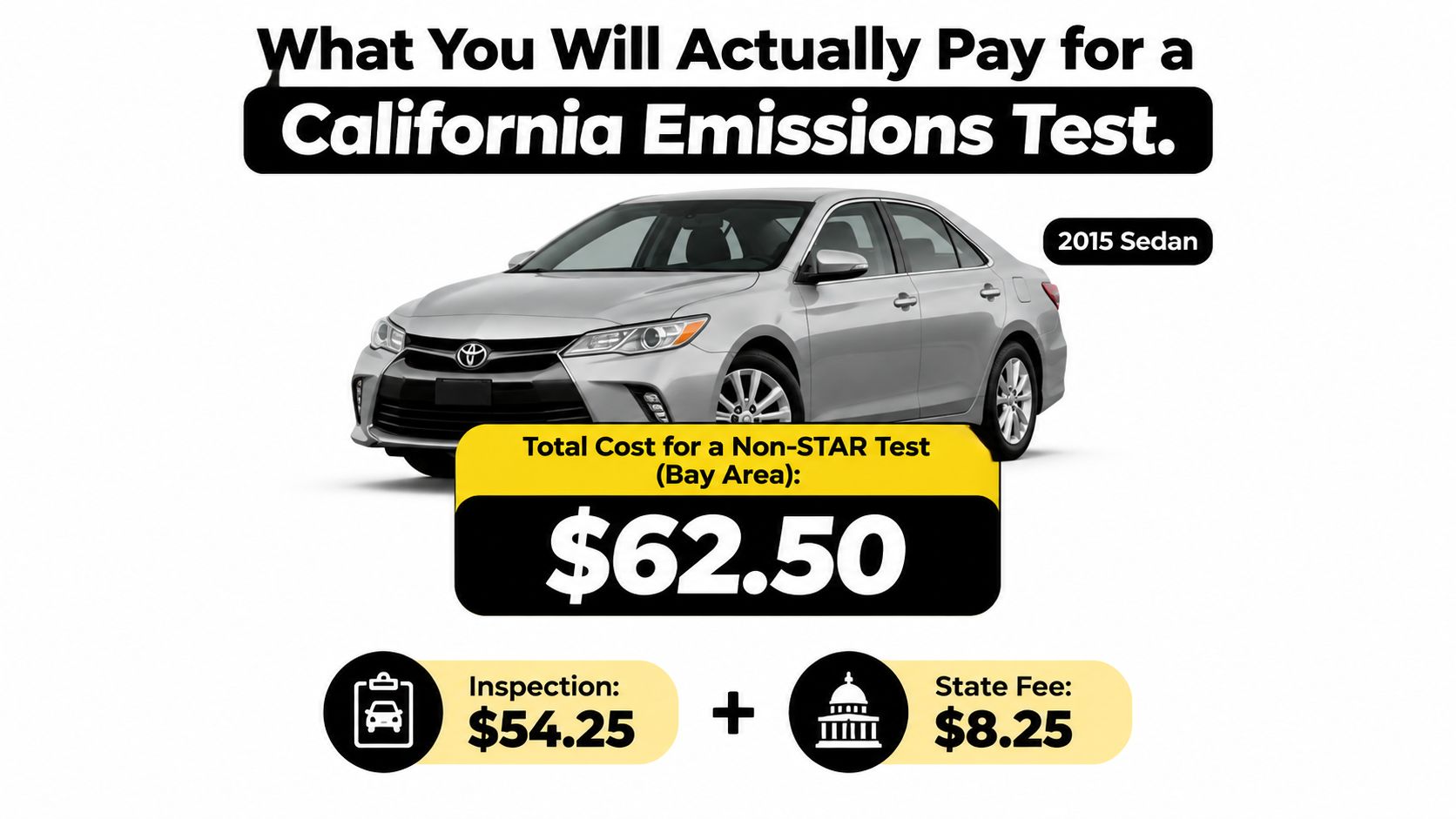
The three numbers to keep in mind
The station inspection fee is where comparison shopping works. Ask for that amount before authorizing the test, and ask whether it includes the complete inspection or only a promotional starting price. The $8.25 certificate fee is fixed and applies to a passing test, so there is no bargaining room there.
The smog abatement fee belongs to DMV registration, not the station's inspection bill. Current DMV materials list it at $20 for newer vehicles exempt from inspection for a period of years. Check the renewal notice to see whether DMV charged it.
Keep the registration line items separate from the smog-test total. If a shop gives you one figure, ask: “How much is the inspection, and is the $8.25 certificate fee included?”
Station Fee Versus State Fee and How They Combine
You can receive two separate charges for one passing test. The licensed station sets the inspection price, while the Bureau of Automotive Repair requires the $8.25 certificate fee. BAR explains this split in its official Smog Check program guidance.
The station fee pays for the inspection work. Depending on the vehicle and test system, it may cover the visual emissions inspection, OBD-II scan, tailpipe measurement, technician time, equipment use, documentation, and shop overhead. A low advertised price may cover the complete test, or it may be only a promotional starting price. Ask before authorizing the inspection.
The certificate fee follows a different rule. It is a state-controlled charge processed through the station's testing system and applies when the vehicle passes. A failed test does not produce a passing certificate, so ask the station how it handles any separate retest or diagnostic charges before work begins.
What belongs on which bill
| Line Item | Amount | Set By | When Charged |
|---|---|---|---|
| Station inspection | Varies by station | Licensed station | When the inspection is performed |
| Smog certificate | $8.25 | State through BAR | On a passing test |
| Smog abatement | $20 in the cited DMV framework | DMV | On qualifying registration transactions |
| Certificate transfer | Verify with DMV before relying on it | DMV | When applicable to a transfer or reissue |
California has run Smog Check through private stations since 1982, which is why no single statewide retail price exists. The station's inspection charge can vary by location, equipment, labor, and business costs. The certificate fee remains fixed, so a shop cannot legitimately remove it to win your business.
The smog abatement line belongs to DMV registration, not the station's inspection bill. Keep it separate from the test total and check your renewal notice for that charge. If a shop quotes one combined figure, ask: “How much is the inspection, and does that include the $8.25 certificate fee?”
That question exposes padded quotes quickly. Compare posted prices at San Leandro smog check stations and confirm whether each quote covers only the inspection or also includes the passing certificate. You can compare the station fee. You cannot bargain away the state-controlled charge.
How Vehicle Type Changes the Price
Your vehicle determines the equipment, procedure, and technician time involved. That's why comparing a quick OBD-II inspection for a newer gasoline car with a tailpipe test for an older vehicle can produce an apples-to-oranges price comparison.
Newer gasoline vehicles commonly use the On-Board Inspection System, or OIS. The technician connects to the vehicle's diagnostic system, checks readiness and emissions-related data, and completes the required visual inspection. A straightforward OIS inspection is usually less demanding than a test requiring a dynamometer and tailpipe equipment.
Older gasoline vehicles can require a BAR-97 procedure. That system uses a tailpipe probe and dynamometer-based testing, which takes more equipment and lane time. The price difference reflects the station's operating cost, not a separate state certificate charge.
Compare the test categories
| Vehicle Type | Test Program | Typical Station Fee | Notes |
|---|---|---|---|
| Newer gasoline vehicle | OIS | Varies by station | OBD-II and visual inspection requirements apply |
| Older gasoline vehicle | BAR-97 where applicable | Varies by station | Tailpipe and dynamometer equipment can affect labor time |
| Diesel vehicle | Applicable diesel inspection procedure | Varies by station | Equipment and vehicle configuration affect the quote |
| Hybrid | OIS or applicable procedure | Varies by station | Diagnostic readiness and hybrid system considerations can affect service time |
| Battery-electric vehicle | No standard smog inspection | No inspection fee | Electric vehicles don't produce tailpipe emissions requiring this test |
BAR's published executive summaries provide a more useful benchmark than bargain advertisements because they separate station types and test platforms. The 2024 report lists a STAR Test-and-Repair OIS average of $72.87, the 2025 report lists $75.82, and the January 2026 report lists $77.55, all before adding the $8.25 certificate fee where the vehicle passes. See the 2024 BAR Smog Check executive summary for the earlier benchmark.
Those averages aren't promises for your neighborhood. A small test-only shop may quote less, while a STAR facility with higher equipment and staffing costs may quote more. Your useful comparison is the same test type at several licensed stations, with the certificate fee identified separately.
What STAR Certification Means for Your Bill
STAR certification is a station designation, not a state-imposed surcharge. It matters because some vehicles must be inspected at STAR stations, and a STAR facility has to meet additional performance and equipment requirements under the BAR program.
The DMV can direct certain vehicles to STAR stations. That can include vehicles identified on a renewal notice, vehicles with prior emissions-related failures, and vehicles that fall within directed or high-emitter categories. Don't choose a shop only because its ad has the lowest number. First confirm whether your renewal notice says STAR is required.
Where the price difference comes from
A STAR station may charge more because it carries additional compliance responsibilities, equipment requirements, documentation duties, and testing procedures. The state certificate charge doesn't change because the vehicle visits a STAR station. The variable amount remains the station's inspection price.
| Factor | Non-STAR Station | STAR-Certified Station |
|---|---|---|
| Station designation | Licensed for eligible inspections | Meets STAR program requirements |
| Vehicle eligibility | Only vehicles allowed by the DMV direction | Can inspect vehicles directed to STAR |
| Inspection price | Set by the station | Set by the station |
| State certificate | $8.25 on a passing test | $8.25 on a passing test |
| Main pricing variable | Labor, equipment, and local competition | Labor, equipment, compliance, and local competition |
The STAR-certified smog station information can help you identify the right station type before you pay for a test. This check is especially important if your renewal paperwork directs you to STAR.
Avoidable expense: If the DMV requires STAR and you use an ineligible station, the test may not satisfy the registration requirement. Verify the station type first, because paying for the wrong inspection can mean paying again.
STAR isn't automatically a bad deal. For a directed vehicle, it's the correct facility. For a vehicle that can use either station type, compare the complete inspection quote, location, service process, and whether the shop clearly explains what happens if the vehicle fails.
Add-On Charges That Push the Total Higher
A failed inspection, a diagnostic check, or a second visit can change the bill quickly. Some added charges pay for real work. Others cover products or services the shop is trying to sell. Ask what each fee covers before approving it.
The $8.25 certificate fee applies to a passing test. It is a state charge, not an optional processing fee created by the station. The inspection price, retest policy, diagnostic work, repairs, and shop-side fees are separate items and should appear clearly in the quote.
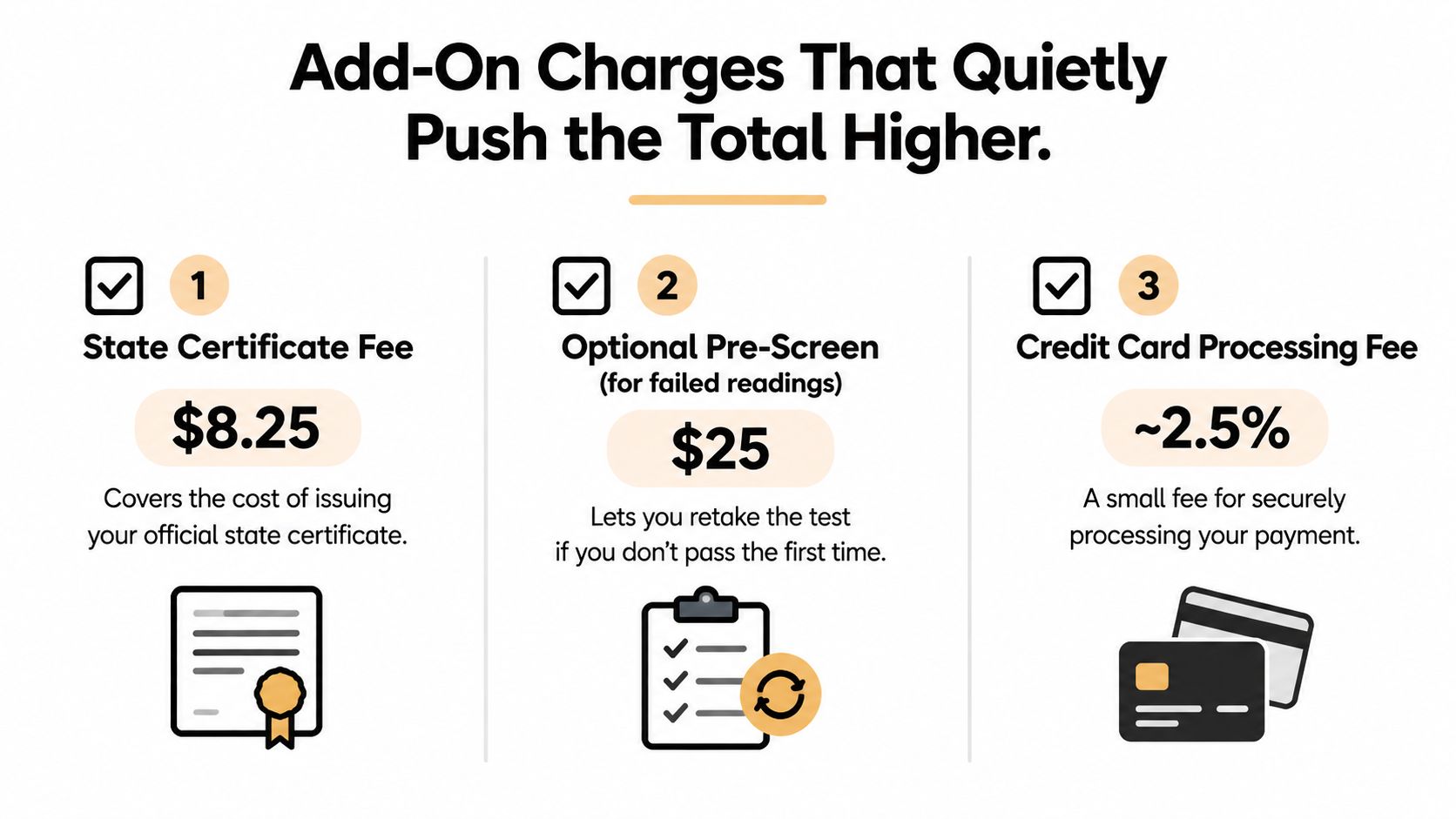
Separate required charges from optional services
- Certificate fee: A fixed state charge applied to a passing result.
- Retest: A second inspection after repairs. The station decides whether its policy makes that free, discounted, or fully chargeable.
- Pre-test or diagnostic: A separate service for checking codes, investigating a warning light, or testing beyond the required inspection.
- Repair work: Work approved by you before it begins. The vehicle may need repairs to pass registration requirements, but the repair price remains a separate decision.
- Convenience or processing charge: A shop-side fee that must be disclosed before payment.
The largest pricing gap often appears after a failure. Ask for the retest policy before authorizing the first inspection. One station may offer a reduced or no-cost retest under stated conditions, while another may charge its normal inspection price after repairs performed elsewhere.
Do not accept a fuel-system cleaner, oil change, or engine-light diagnostic as a condition of a routine test unless the technician explains the vehicle-specific reason. These services can have a maintenance purpose, but they are not automatically part of the emissions inspection.
Use the same caution with a certificate transfer or DMV transaction. If ownership or registration details change, confirm the required charge with the DMV before treating a station-side fee as mandatory. State-controlled requirements are outlined on the California DMV smog inspection page.
Smart Ways to Lower Your Emissions Test Cost
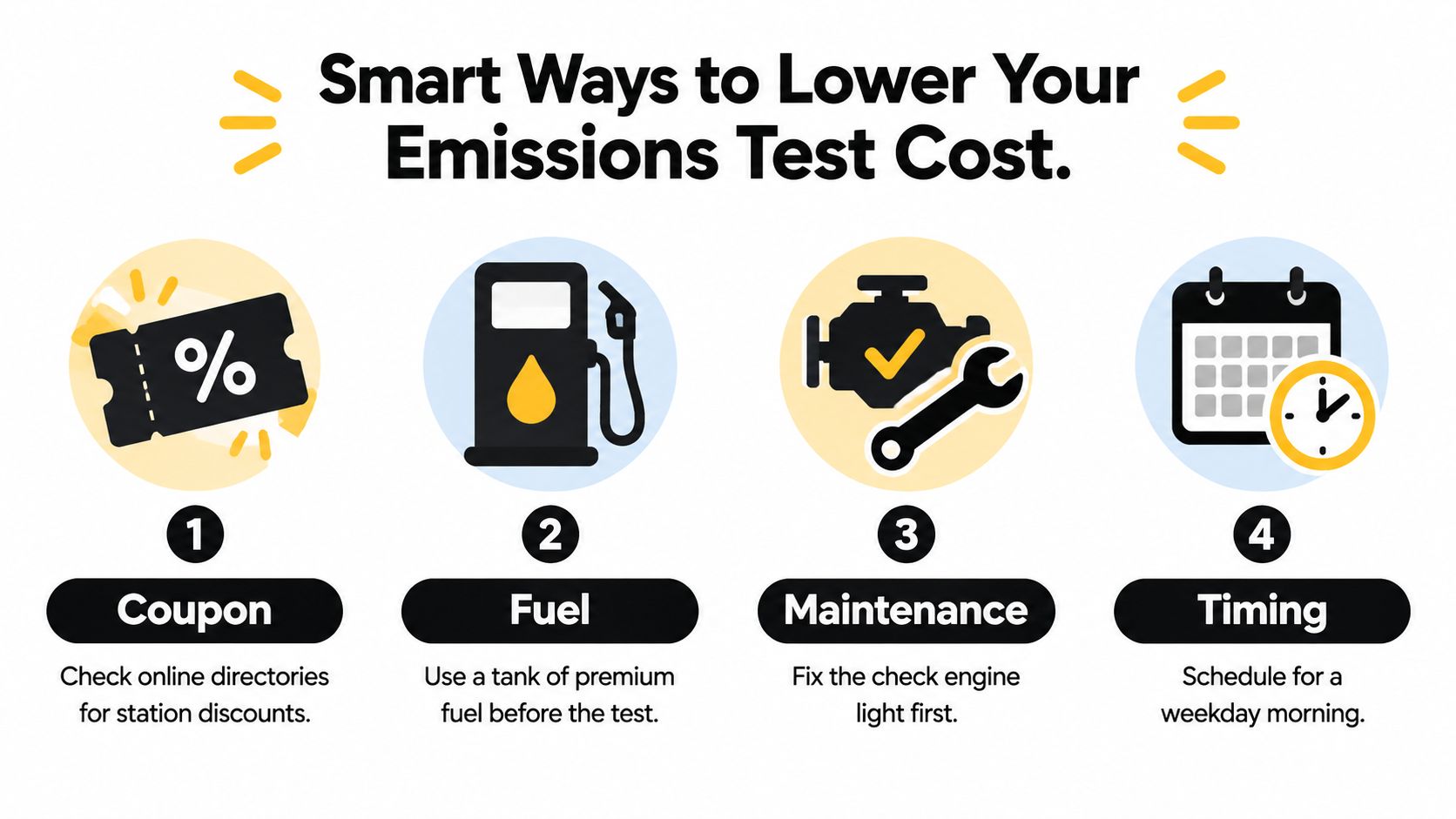
You can reduce the bill without choosing an inferior test. Start by comparing the station inspection fee, then check for a current coupon before booking. A discount applies to the negotiable part of the transaction, not to the fixed state charge.
Use a simple checklist:
- Check the complete quote: Ask for the inspection price, certificate treatment, retest policy, and any payment surcharge before arriving.
- Verify STAR eligibility: Read the DMV renewal notice. If STAR is required, don't waste money at a station that cannot complete the required inspection.
- Look for a current offer: Station websites, coupon pages, and member programs may publish discounts. The Speedy Smog coupon page is one local example to check before scheduling.
- Choose a quieter appointment: Some stations price weekday or off-peak appointments differently. Ask rather than assuming the online price is the only price.
- Fix warning lights first: A lit check-engine light can lead to a failed inspection, and a diagnostic service afterward is more expensive than identifying the problem before the test.
- Arrive with the vehicle ready: Bring the car in normal operating condition, avoid clearing codes immediately before testing, and follow any preparation instructions from the station.
Vehicle preparation can prevent an avoidable aborted test, but don't rely on internet shortcuts such as premium fuel or improvised repairs to make a defective emissions system pass. The best preparation is a functioning vehicle with no unresolved emissions warning.
The registration abatement fee is a separate DMV charge for qualifying newer vehicles, not a discount you can negotiate at the station. If your vehicle requires a test, passing on the first attempt avoids the cost and disruption of a failure and retest, but it doesn't erase a DMV fee that applies under the registration rules.
A short explainer can also help you understand the inspection process before you book:
Putting It All Together for East Bay Drivers
An East Bay driver should price the inspection in two stages. First, identify the correct station and test platform. Second, add the fixed $8.25 certificate fee if the vehicle passes.
For example, a STAR station may quote an inspection price for a newer hybrid and then add the certificate fee to the passing total. The hybrid's diagnostic procedure can require careful readiness verification, so the shop should explain what its inspection price includes before testing begins. Ask whether the quote covers the complete inspection or only the station's base labor.
A practical pricing recap
| Vehicle Type | Test Type | Inspection Fee | Certificate Fee | Estimated Total |
|---|---|---|---|---|
| Newer gasoline vehicle | OIS | Station-set | $8.25 if passed | Inspection plus certificate |
| Older gasoline vehicle | BAR-97 where applicable | Station-set | $8.25 if passed | Inspection plus certificate |
| Hybrid | Applicable OIS procedure | Station-set | $8.25 if passed | Inspection plus certificate |
| Diesel | Applicable diesel procedure | Station-set | $8.25 if passed when required | Inspection plus certificate |
STAR shouldn't be treated as a mysterious surcharge. It identifies a station qualified for vehicles that the DMV directs into that program. The price difference, when one exists, comes from the station's labor, equipment, compliance workload, and local operating costs.
For East Bay drivers, the useful memory aid is simple: the station inspection fee is variable, the passing certificate fee is $8.25, and the DMV's cited smog abatement fee is $20 for qualifying newer vehicles. Keep those charges separate, and a confusing quote becomes easy to evaluate.
Speedy Smog provides STAR-certified inspections in San Leandro, including service for newer vehicles, older vehicles, diesels, and hybrids, with transparent station pricing and a comfortable indoor waiting area. Check the current inspection quote and available offer, then visit Speedy Smog with your DMV renewal information before testing.