
Smog Check Catalytic Converter Guide for California Drivers
Replacing a catalytic converter is not a smog-check strategy. It's one repair in an emissions system that includes sensors, computer monitors, exhaust plumbing, and the converter itself. I've seen plenty of drivers arrive with a brand-new part and still leave with a failure because the check-engine light was on, the monitors weren't ready, or the replacement converter had the wrong California approval marking.
California checks more than whether a converter is hanging under the car. Inspectors verify the correct equipment, its location, its condition, and the vehicle's emissions-system data. This guide explains what the converter does, how a smog check catalytic converter inspection works, which California rules matter, why replacement jobs fail, and how to decide between diagnosis and another parts purchase.
Table of Contents
- Why a New Catalytic Converter Does Not Guarantee a Pass
- What a Catalytic Converter Actually Does
- How Smog Inspections Evaluate Your Converter
- California Rules Every Driver Should Know
- Common Ways Drivers Still Fail After a Converter Swap
- Pre-Smog Checklist You Can Run in Your Driveway
- Repair Versus Replacement and Where to Get Tested
Why a New Catalytic Converter Does Not Guarantee a Pass
The popular advice is simple: replace the catalytic converter, clear the code, and go get a smog check. That advice is incomplete and can waste your money.
A California inspection evaluates the emissions system as a package. The converter matters, but so do the upstream and downstream oxygen sensors, fuel-control operation, EVAP system, EGR equipment where applicable, engine temperature, exhaust leaks, and the PCM's readiness monitors. A replacement part won't correct a sensor that still reports inefficient catalyst operation, a misfire that damages the new substrate, or a monitor that hasn't completed its required drive conditions.
California inspectors also look at the converter itself. The California Smog Check manual explains that inspectors verify the converter is in the correct location, undamaged, unmodified, and properly approved when it's an aftermarket unit. A converter can be physically present and still fail the visual inspection if the marking can't be validated or the installation doesn't match the vehicle's requirements.
Counter advice: Don't ask only, “Did I replace the converter?” Ask, “Is the whole emissions system ready to be tested?”
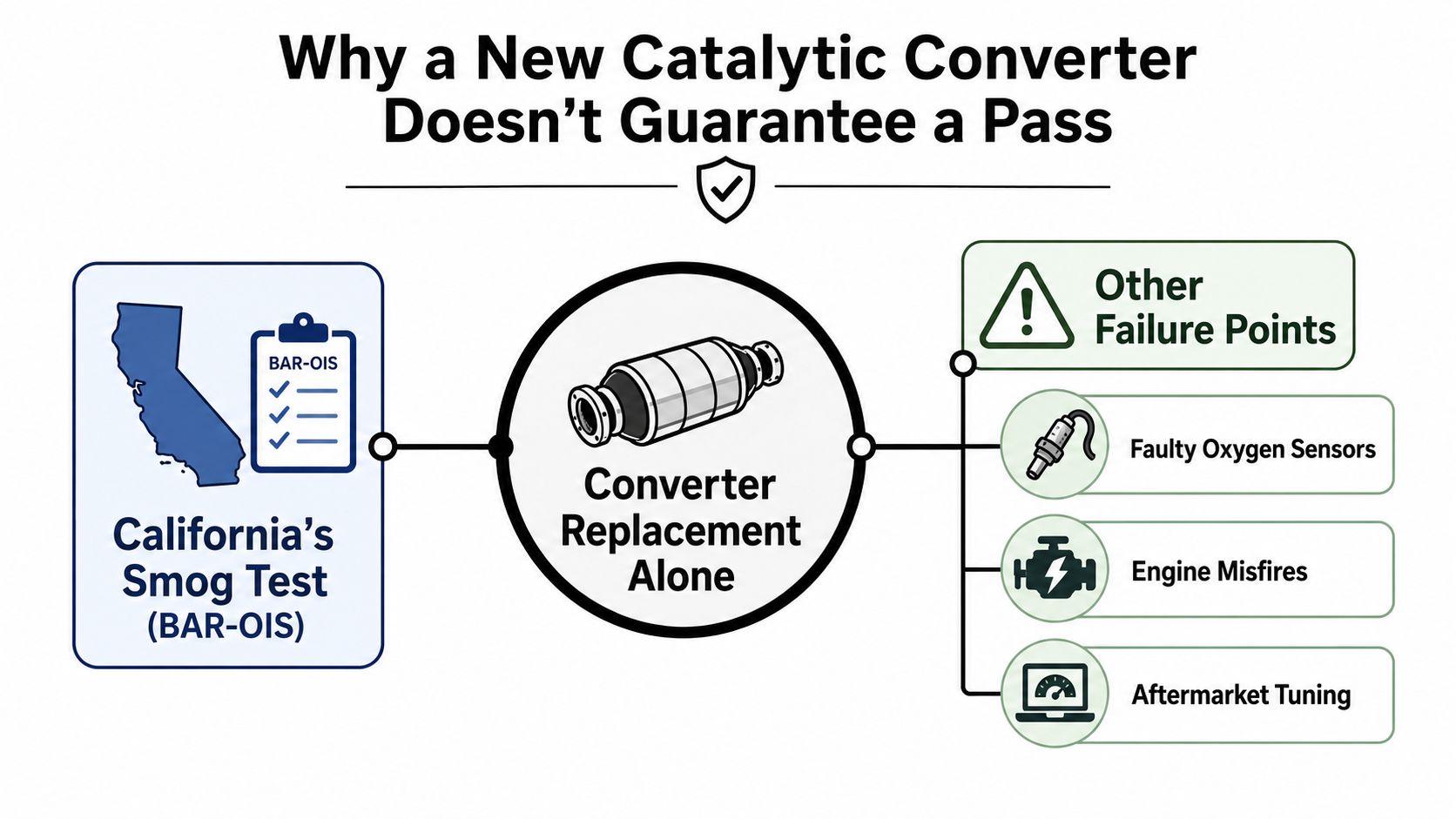
A pending or stored efficiency code, incomplete OBD monitors, an incompatible aftermarket part, or an illuminated check-engine light can stop the test even when the engine seems to run normally. The converter may be new, but the car still has to prove that its sensors and computer can monitor emissions performance.
The right approach is diagnostic. Confirm the code, inspect the exhaust and sensors, verify the replacement part, check readiness, and only then schedule the inspection.
What a Catalytic Converter Actually Does
A gasoline engine produces several pollutants during combustion. Carbon monoxide forms when fuel doesn't burn completely. Hydrocarbons are unburned fuel and combustion byproducts. Nitrogen oxides, commonly called NOx, form when combustion temperatures allow nitrogen and oxygen to combine.
The converter reduces those pollutants before the exhaust reaches the tailpipe. Inside the housing is a ceramic honeycomb or metallic substrate with a high-surface-area coating that contains precious-metal catalysts such as platinum, palladium, and rhodium. The metals promote chemical reactions without being consumed in the process.
A modern three-way converter handles three jobs:
- It oxidizes carbon monoxide into carbon dioxide.
- It oxidizes hydrocarbons into carbon dioxide and water.
- It reduces NOx into nitrogen and oxygen.
Older systems may use separate oxidation and reduction sections, while modern vehicles commonly combine the reactions in one three-way assembly. The converter has to reach operating temperature before those reactions work effectively, which is why cold-start behavior, warm-up, fuel mixture, ignition, and exhaust flow all affect inspection results.
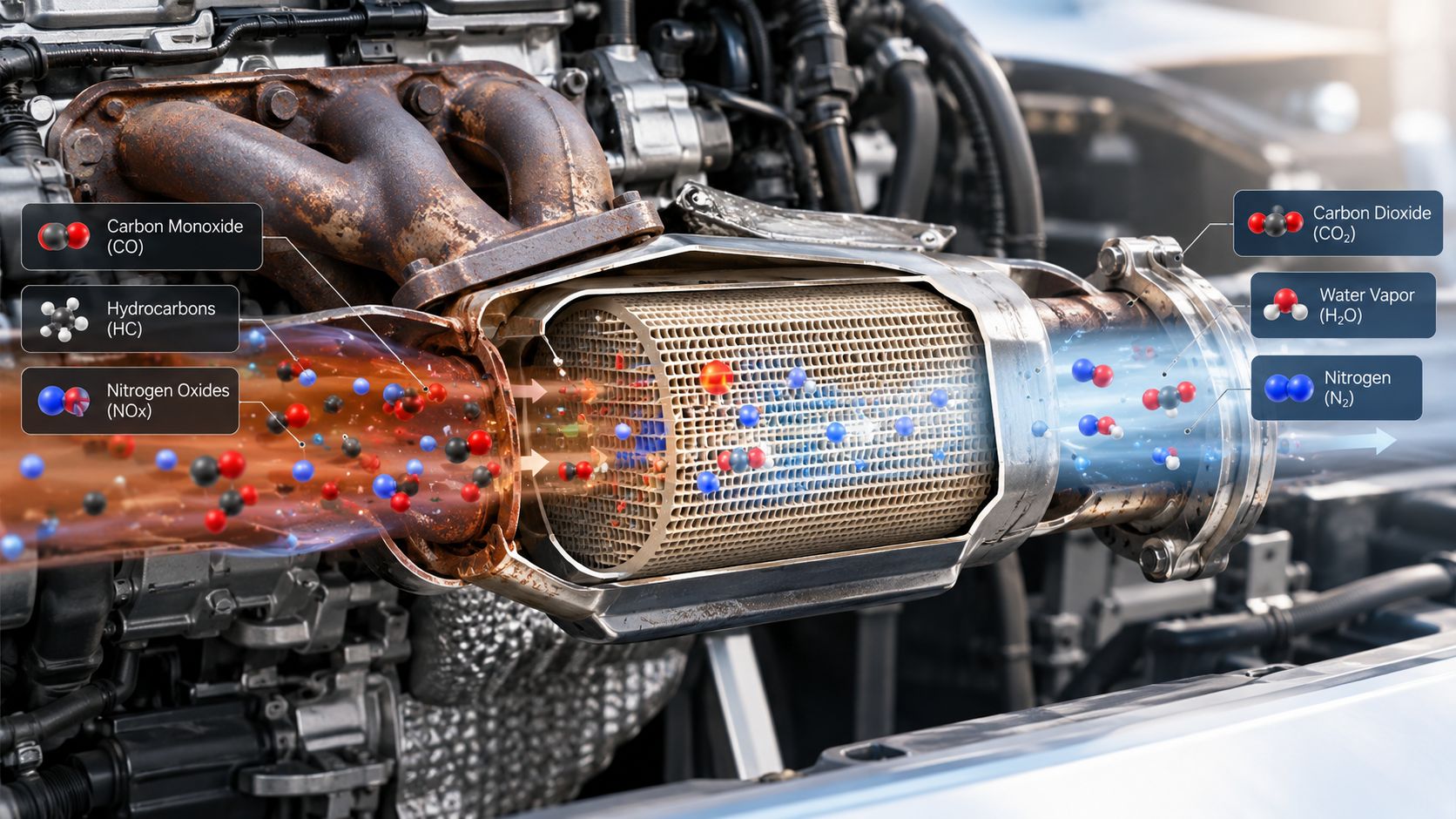
The oxygen sensors provide the computer with information about the exhaust before and after the converter. The upstream sensor helps the PCM adjust the air-fuel mixture. The downstream sensor helps the PCM judge whether the converter is storing oxygen and smoothing out the exhaust signal as it should.
That placement is deliberate. The converter sits in the exhaust path between the engine and muffler, with sensor locations selected to let the PCM compare exhaust behavior on both sides. A technician may use scan data, code information, visual inspection, and emissions measurements to determine whether the unit is doing more than occupying space under the vehicle.
For a plain-language explanation of the component itself, see this guide to how a catalytic converter functions. Understanding the chemistry makes the inspection rules easier to follow. The inspector isn't judging the part by appearance alone. The inspection is looking for evidence that the exhaust-cleanup process still works.
How Smog Inspections Evaluate Your Converter
A new converter can still fail a California smog check. The inspector evaluates the entire emissions system, including the converter's installation, sensor data, fault codes, readiness monitors, and measured exhaust. Presence isn't proof of performance.
Visual inspection checks the hardware
The technician verifies that the required number of converters is installed in the original locations. Each housing should be secure, undamaged, and free of obvious modification, removal, or bypass work.
Aftermarket units receive close attention. California requires an aftermarket converter to carry a valid CARB Executive Order, or EO, number for the specific vehicle application. The California Energy Commission catalytic-converter materials explain that the Smog Check process verifies the correct converter, proper installation, and unmodified condition. Since January 1, 2009, aftermarket converters in California have needed an ARB EO number to pass the catalyst visual inspection.
A missing, unreadable, or mismatched marking can fail the vehicle even when it drives normally. A technician can also reject a converter that is present but mounted in the wrong position.
The computer scan checks stored evidence
For vehicles covered by OBD testing, the station connects a scan tool to the diagnostic connector. The technician checks for an illuminated malfunction indicator, stored emissions codes, pending codes where relevant, and readiness monitor status.
The catalyst monitor matters, but the inspection covers other required monitors too, including EVAP, oxygen-sensor, and EGR systems. Clearing codes before the appointment may remove the immediate fault while leaving monitors incomplete. The vehicle can then fail because the system has not completed its checks.
The downstream oxygen sensor should show behavior consistent with a working converter. A signal that closely imitates the upstream sensor can point to poor oxygen storage or weak conversion. Scan data cannot replace the visual inspection, and a stable sensor reading does not excuse an incorrect or improperly installed converter.
Tailpipe testing measures actual emissions
Older applicable vehicles may receive tailpipe testing in dynamometer modes such as ASM or TSI. The equipment measures HC, CO, and NOx against the vehicle's applicable limits.
EPA materials report that catalytic converters reduce carbon monoxide and hydrocarbons by more than 90%, and NOx by up to 70%. The same material states that, by 1998, converters had cut 20 million tons of CO, 2 million tons of HC, and 1 million tons of NOx in the United States. Those results show why converter performance matters, but a replacement part still has to match the vehicle and work with the rest of the emissions system.
| Inspection Layer | What It Checks on the Converter | Applies To |
|---|---|---|
| Visual and tampering inspection | Presence, location, condition, mounting, and valid EO marking | Vehicles subject to visual equipment checks |
| OBD scan | Catalyst performance data, codes, and readiness monitors | Applicable OBD-equipped vehicles |
| Tailpipe measurement | HC, CO, and NOx output under test conditions | Applicable vehicles receiving tailpipe testing |
California Rules Every Driver Should Know
California's smog rules can fail a vehicle before the tailpipe numbers become the main issue. The station type, converter approval, vehicle category, and inspection format all matter. A new converter does not override any of them.
Start with the station listed for your vehicle. A vehicle directed to a STAR station, including one designated a gross polluter or placed on the DMV no-pass list after a previous failure, must receive certification from a STAR-certified station. A regular test-only location cannot replace that required STAR inspection.
California also restricts replacement converters. A universal unit is not acceptable because it fits the exhaust or produces passing emissions. The aftermarket converter must be approved for the vehicle and carry a verifiable CARB Executive Order number. Inspectors also check the number of converters, their original locations, and signs that someone modified, bypassed, or removed emissions equipment.
Certain vehicles meeting the 8-year and 8,000-mile conditions in California's aftermarket-converter rules may use an EPA-compliant aftermarket unit marked with the appropriate ARB EO number instead of the original-equipment unit. That allowance does not make every replacement legal. The part still must match the vehicle and its application.
Know which vehicles fall outside normal testing
California exempts several categories from routine smog checks:
- 1975 and older vehicles
- Diesel vehicles above 14,000 pounds GVWR
- Motorcycles
- Natural-gas vehicles above 14,000 pounds
- Certain specialty vehicles
Smog requirements commonly appear during registration renewal, a vehicle sale, or a transfer. Qualifying vehicles generally follow a biennial renewal cycle, but the DMV notice determines the obligation for your vehicle.
California began applying OBD-based testing to 1996 through 1999 vehicles in 2025. Those inspections combine scan information with visual emissions-equipment checks instead of relying only on a tailpipe test. Check the California smog-check rules guide if you are unsure whether your vehicle needs a STAR station or which test format applies.
| Vehicle Category | Test Required | Where to Test |
|---|---|---|
| STAR-directed vehicle | STAR inspection and certification | STAR-certified station |
| Applicable OBD-equipped vehicle | OBD scan plus required visual checks | Authorized smog station |
| Applicable older vehicle | Required inspection format, which may include tailpipe testing | Authorized station approved for that vehicle |
| Exempt category | No routine smog certification under the exemption | No smog station required for that exemption |
Read the DMV notice before choosing a shop. Confirm whether it specifies STAR, then tell the technician about recent converter or sensor work before testing starts.
Common Ways Drivers Still Fail After a Converter Swap
A driver replaces the converter, sees no obvious engine problem, and expects a certificate. Then the technician finds one of the following.
The check-engine light stayed on
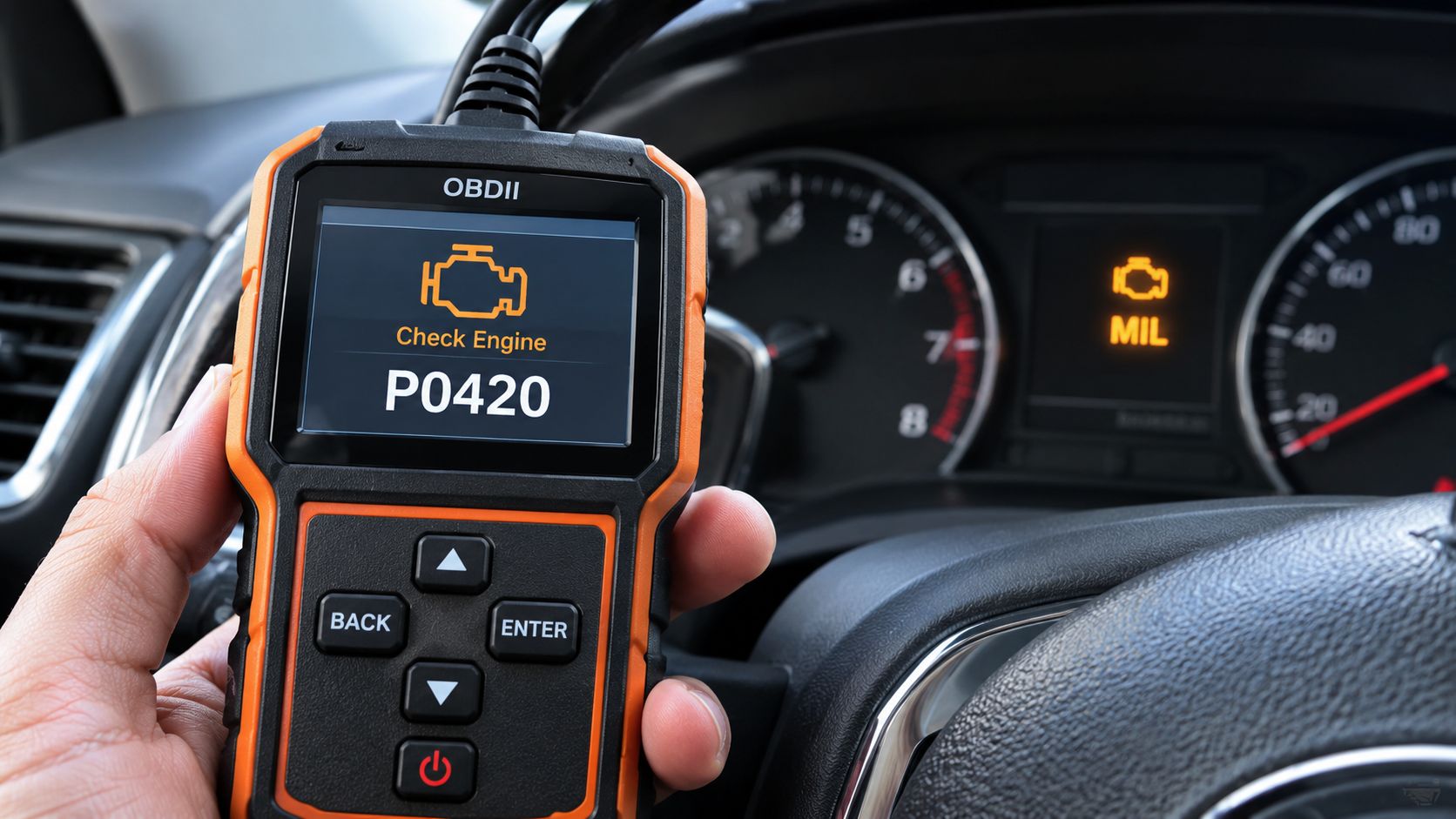
An illuminated check-engine light means the vehicle fails the emissions inspection. A new converter won't repair a downstream oxygen sensor that keeps reporting inefficient catalyst operation. It also won't solve a misfire, fuel-control problem, EVAP fault, or wiring issue that caused the code in the first place.
Codes such as P0420 or P0430 point toward catalyst efficiency, but they're not a license to replace the part without testing. A leak near a sensor, incorrect sensor installation, damaged wiring, or an engine problem can produce the same kind of complaint.
The EO marking is wrong or missing
A replacement converter may fit the pipe perfectly and still be illegal for that application. If the EO number is absent, unreadable, invalid, or assigned to another vehicle family, the visual inspection can fail.
Don't wait until inspection day to discover this. Ask the installer to show you the marking and confirm that the part matches the vehicle's application.
The monitors aren't ready
The PCM needs suitable driving conditions after codes are cleared or parts are replaced. A short trip directly from the repair shop may not complete catalyst, EVAP, oxygen-sensor, or secondary-air monitors.
The car can run smoothly while the inspection remains blocked by incomplete data. Check readiness with an OBD scanner before booking.
The exhaust installation has visible defects
A leaking flange, cracked flex pipe, loose hanger, or missing heat shield can raise safety and emissions concerns. A leak can also pull outside air toward an oxygen sensor and distort the signal used to judge converter operation.
A converter that rattles internally, sits in the wrong location, or shows obvious tampering deserves attention before the test.
The engine condition undermines the new part
A misfire, oil contamination, incorrect fuel mixture, or poor temperature control can overload or poison the catalyst. Replacing the converter without correcting the cause often turns an expensive new part into another failed component.
Stale fuel and a cold exhaust system can also affect test behavior. Arrive with the vehicle operating normally, and tell the technician about recent repairs rather than trying to conceal them.
Pre-Smog Checklist You Can Run in Your Driveway
A new catalytic converter does not make the rest of the emissions system pass automatically. Check the dashboard, monitor status, visible exhaust hardware, and appointment details before paying for an inspection.
Check the dashboard and scan data
If the check-engine light is on, postpone the smog test. Use an OBDII scanner, borrow one from a parts store, or ask a repair shop to check stored and pending codes.
Review readiness status as well. Required monitors should show Ready or Complete, not Not Ready. Disconnecting the battery, clearing a code, or replacing a converter or sensor can reset the monitors. The PCM needs normal driving conditions to complete its checks.
Start the drive cycle with the vehicle warmed up so the converter and oxygen sensors reach operating temperature. Combine ordinary city driving with sustained faster-road driving, then scan the vehicle again before the appointment. Do not rely on a guessed mileage target. The monitor display is the evidence that matters.
For guidance on the warning light, read clearing a check-engine light correctly. Clearing the light without repairing the fault only hides the symptom and can leave the monitors incomplete.
Inspect visible hardware
With the vehicle cool and safely parked, check for rust holes, loose hangers, cracked pipe sections, missing heat shields, and soot around flanges. Never crawl under a vehicle supported only by a jack. If the converter marking is not visible from a safe position, have a technician inspect it.
Confirm that the replacement converter has a legible EO sticker or stamp. Keep the repair invoice and part information with the vehicle records. These documents help verify what was installed if the inspector questions the part.
Prepare for the appointment
Check the fuel level and tire pressure. Bring the DMV renewal notice and payment. Tell the station about any recent converter, oxygen sensor, battery, or engine repair.
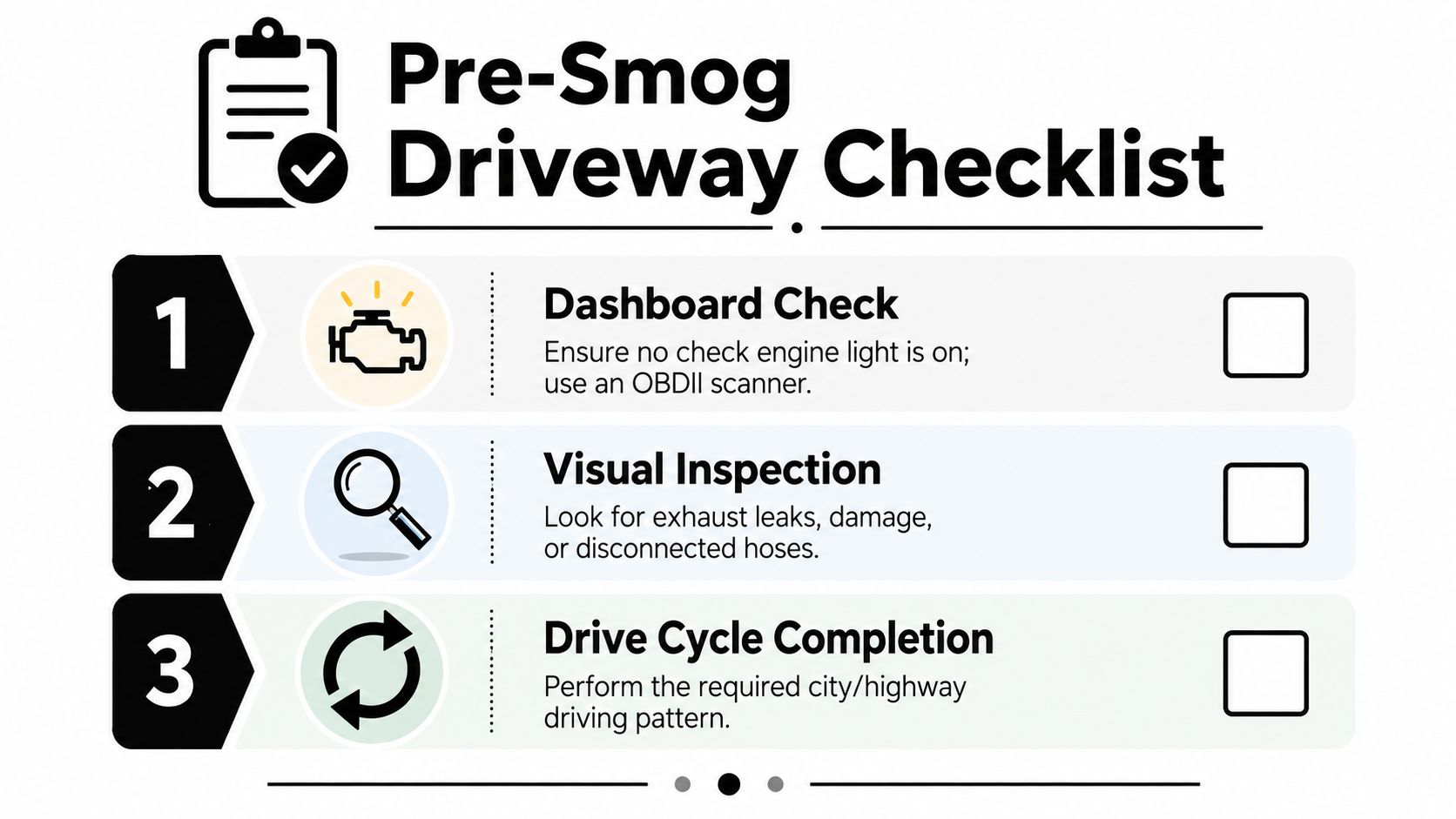
Use this visual walkthrough to organize the basic checks before visiting a station.
Repair Versus Replacement and Where to Get Tested
Confirm the diagnosis before approving a converter replacement. A sensor, exhaust leak, vacuum leak, wiring fault, fuel-control problem, or software issue can trigger a catalyst-efficiency code. Replacing the converter first can leave the underlying fault unresolved and make you pay twice.
Repair is the right choice when the converter remains physically sound and testing identifies a correctable cause. An oxygen sensor, exhaust leak, or calibration problem may restore proper monitoring. Replacement is necessary when the substrate is broken, contaminated by oil, melted after a misfire, physically damaged, or confirmed to have lost conversion capability.
The decision usually follows two practical paths:
| Option | Typical Cost | Timeline | Best When |
|---|---|---|---|
| Sensor, leak, or control-system repair | $150 to $600 | Often same-week | The converter is sound and another fault caused the failure |
| CARB-compliant converter with installation | $1,000 to $2,500 | Several days when parts must be ordered | The converter is damaged, contaminated, or confirmed inefficient |
Treat those figures as planning ranges, not guarantees. Get the diagnosis in writing, and verify that any replacement converter carries the correct California approval for your vehicle. Ask whether the technician checked what caused the original failure, particularly if the old converter melted or broke apart. A new part cannot compensate for an unresolved misfire, fuel-control fault, or sensor problem.
Before booking the test, confirm whether your DMV notice requires a STAR station. A STAR-certified shop can perform the applicable OBD assessment, inspect the converter markings, and transmit a passing certificate electronically. Speedy Smog in San Leandro performs standard and STAR-directed smog checks, including OBDII assessments, so the inspection evaluates the emissions system rather than only confirming that a part was installed.
Bring the repair invoice and part information. Have the readiness monitors, scan data, and EO marking checked before the appointment, especially after recent converter, oxygen-sensor, battery, or engine work. That final review catches problems a brand-new converter cannot fix.