
Catalytic Converter Function Explained for Vehicle Owners
You've just arrived for a smog check, and the technician mentions a catalytic converter code. The check engine light may be on, the car may still drive normally, and you're left wondering whether you're facing an immediate replacement or a smaller engine-control problem.
That confusion is common because a catalytic converter isn't a simple filter. Its performance depends on exhaust temperature, air-fuel control, oxygen sensors, fuel quality, and the condition of the engine sending gases into it. Understanding catalytic converter function helps you make a better repair decision and avoid replacing an expensive component before anyone has confirmed the cause.
Table of Contents
- Why Your Catalytic Converter Matters More Than You Think
- How a Catalytic Converter Reduces Harmful Emissions
- The Hidden Chemistry That Keeps It Working
- Why Converters Degrade and Replacement Costs Are Rising
- When a Converter Code Is Not Really a Converter Problem
- What This Means for Your Smog Check and Vehicle Maintenance
- Key Takeaways for East Bay Drivers
Why Your Catalytic Converter Matters More Than You Think
A car can arrive at a smog check with normal power, smooth acceleration, and no unusual noise, yet still fail its emissions test. The onboard diagnostic system may detect that the converter is reducing pollutants less effectively than expected, even when the driver notices no change.
That result calls for testing rather than an automatic replacement. The converter processes combustion byproducts in the exhaust, but its performance depends on the engine, fuel control, oxygen sensors, exhaust temperature, and a sealed exhaust path. A misfire, incorrect fuel mixture, or exhaust leak can make a functioning converter appear weak.
The converter is part of an active system
Catalytic converters became a major emissions-control milestone in the mid-1970s. The first converters were installed in cars for the 1975 model year. The three-way catalyst introduced in 1976 later enabled vehicles to address hydrocarbons, carbon monoxide, and nitrogen oxides together, as documented in this history of Carl D. Keith and catalytic converter development.
“Three-way” describes three separate pollution-control tasks:
- Hydrocarbons: Unburned fuel compounds.
- Carbon monoxide: A product of incomplete combustion.
- Nitrogen oxides: Compounds formed during high-temperature combustion.
A mature three-way system has achieved reported removal of about 97% of tailpipe hydrocarbons, 96% of carbon monoxide, and 90% of nitrogen oxides in light-duty vehicles and sport utility vehicles. Those figures describe suitable operating conditions, not a guarantee for every vehicle, fault, or driving situation.
For a smog check technician, the diagnostic code is a starting point. It identifies a measured emissions problem, while further tests determine whether the catalyst is damaged or an upstream fault is disrupting its operation.
Practical rule: A converter code does not, by itself, prove that the converter is the root cause.
For East Bay drivers preparing for DMV registration renewal, this distinction can prevent an unnecessary repair. Confirming the engine and exhaust conditions first helps separate a failed catalyst from a problem that is keeping a healthy catalyst from working efficiently.
How a Catalytic Converter Reduces Harmful Emissions
During a smog check, a converter code can make the component look guilty immediately. The converter may be reacting to an upstream engine problem. Understanding its job helps you see why diagnosis must follow the exhaust chemistry, not stop at the code.
Think of the converter as a chemical sorting facility in the exhaust pipe. Hot exhaust passes through a honeycomb substrate coated with catalytic materials. Those materials encourage reactions that rearrange harmful compounds instead of trapping pollutants in a container.
Step one is exposing the exhaust to a large reaction surface
Inside the metal housing, the substrate contains many narrow passages. This honeycomb design gives exhaust gases broad contact with the coated surface while keeping the stream moving. The coating contains precious-metal catalysts, including platinum, palladium, and rhodium. These metals speed reactions without being consumed like fuel or a filter medium.
Several parts must work together:
| Component | Function |
|---|---|
| Heat-resistant housing | Protects the internal catalyst assembly and contains exhaust flow |
| Honeycomb substrate | Provides extensive surface area for reactions |
| Washcoat | Distributes catalytic materials and supports oxygen storage |
| Precious-metal catalysts | Encourage oxidation and reduction reactions |
The exhaust carries three main regulated pollutants. The converter addresses them through two broad chemical processes.
Reduction removes oxygen from nitrogen oxides
The reduction side targets nitrogen oxides. The catalyst helps separate these compounds so nitrogen can leave mainly as nitrogen gas, a far less troublesome part of normal air. The term “reduction” refers to removing oxygen from the nitrogen-oxide compounds.
Oxidation adds oxygen to carbon monoxide and hydrocarbons
The oxidation side handles carbon monoxide and unburned hydrocarbons. The catalyst promotes reactions that add oxygen, converting carbon monoxide into carbon dioxide and helping turn hydrocarbons into carbon dioxide and water vapor.
The U.S. Department of Energy reports that catalytic converters reduce carbon monoxide and hydrocarbon emissions by more than 90% and nitrogen oxides by up to 70%. Its historical summary also says that in 1998, the technology cut emissions by 20 million tons of CO, 2 million tons of HC, and converted 1 million tons of NOx into less harmful by-products. These figures appear in the U.S. Department of Energy catalytic converter summary.
For diagnosis, the practical point is simple: the converter creates the reaction site, while the engine-control system must deliver exhaust that the catalyst can process. A converter code may therefore indicate damaged catalyst material, or it may reflect an upstream fault that is sending the wrong mixture, excess fuel, or other abnormal exhaust into a still-functioning converter.
The Hidden Chemistry That Keeps It Working
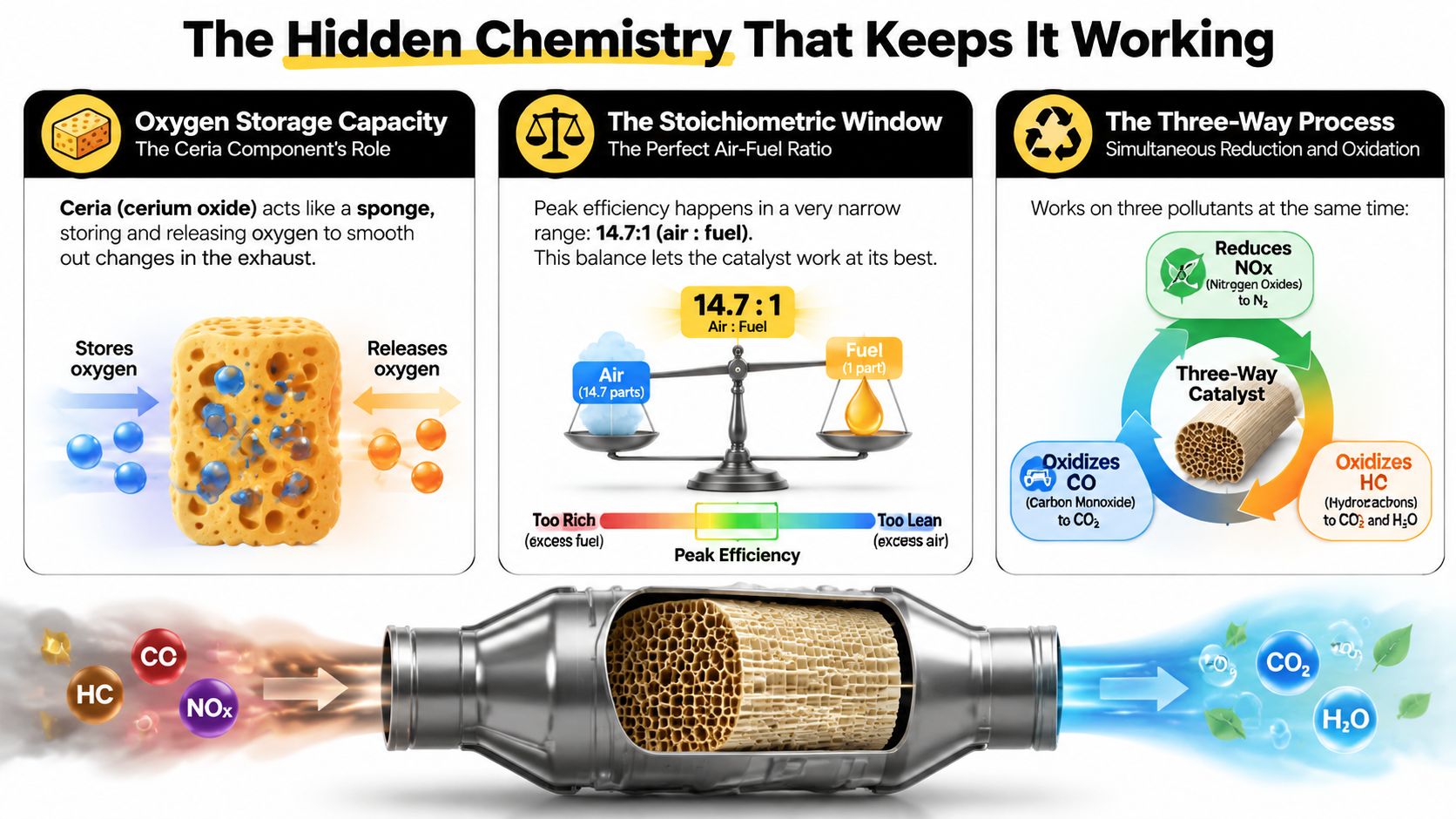
A three-way converter works most effectively near the stoichiometric air-fuel ratio, the narrow balance point where the exhaust contains the right conditions for reducing nitrogen oxides while oxidizing carbon monoxide and hydrocarbons. The engine computer constantly adjusts fuel delivery around that target because real driving never holds the mixture perfectly still.
During a lean moment, the engine receives relatively more air. During a rich moment, it receives relatively more fuel. Throttle changes, acceleration, deceleration, and sensor corrections can move the exhaust back and forth between those conditions.
Ceria acts like a chemical battery
The converter uses a ceria-based washcoat to buffer those swings. Ceria can store oxygen during lean excursions and release oxygen during rich excursions. That stored oxygen gives the oxidation reactions access to what they need even when the immediate exhaust mixture has changed.
The process resembles a rechargeable chemical sponge:
- Lean exhaust arrives, carrying excess oxygen.
- The ceria component stores some of that oxygen.
- Rich exhaust arrives, carrying more carbon monoxide and unburned hydrocarbons.
- The washcoat releases stored oxygen, helping the converter oxidize those pollutants.
This buffering is why a modern converter is better understood as an active chemical reactor than as a passive filter. Technical analysis of three-way catalysts explains that oxygen storage is controlled by exhaust composition, temperature, and catalyst condition. It can therefore change during rapid throttle transitions and as the converter ages, as described in this technical review of oxygen storage behavior.
Why oxygen sensors matter during a smog diagnosis
The oxygen sensors before and after the converter give the vehicle computer information about exhaust conditions and catalyst behavior. The upstream sensor helps the engine computer control the mixture, while the downstream sensor helps it evaluate whether the converter is changing the exhaust as expected.
If the upstream sensor responds incorrectly, the engine may run too rich or too lean. If the exhaust contains an outside-air leak, the downstream sensor may report oxygen that didn't come from the combustion process. In either case, the computer may identify poor converter performance even when the converter itself isn't the first component that needs replacement.
That's why technicians look at sensor data, fuel-control information, misfire history, and exhaust integrity rather than treating one diagnostic code as a complete answer.
Why Converters Degrade and Replacement Costs Are Rising
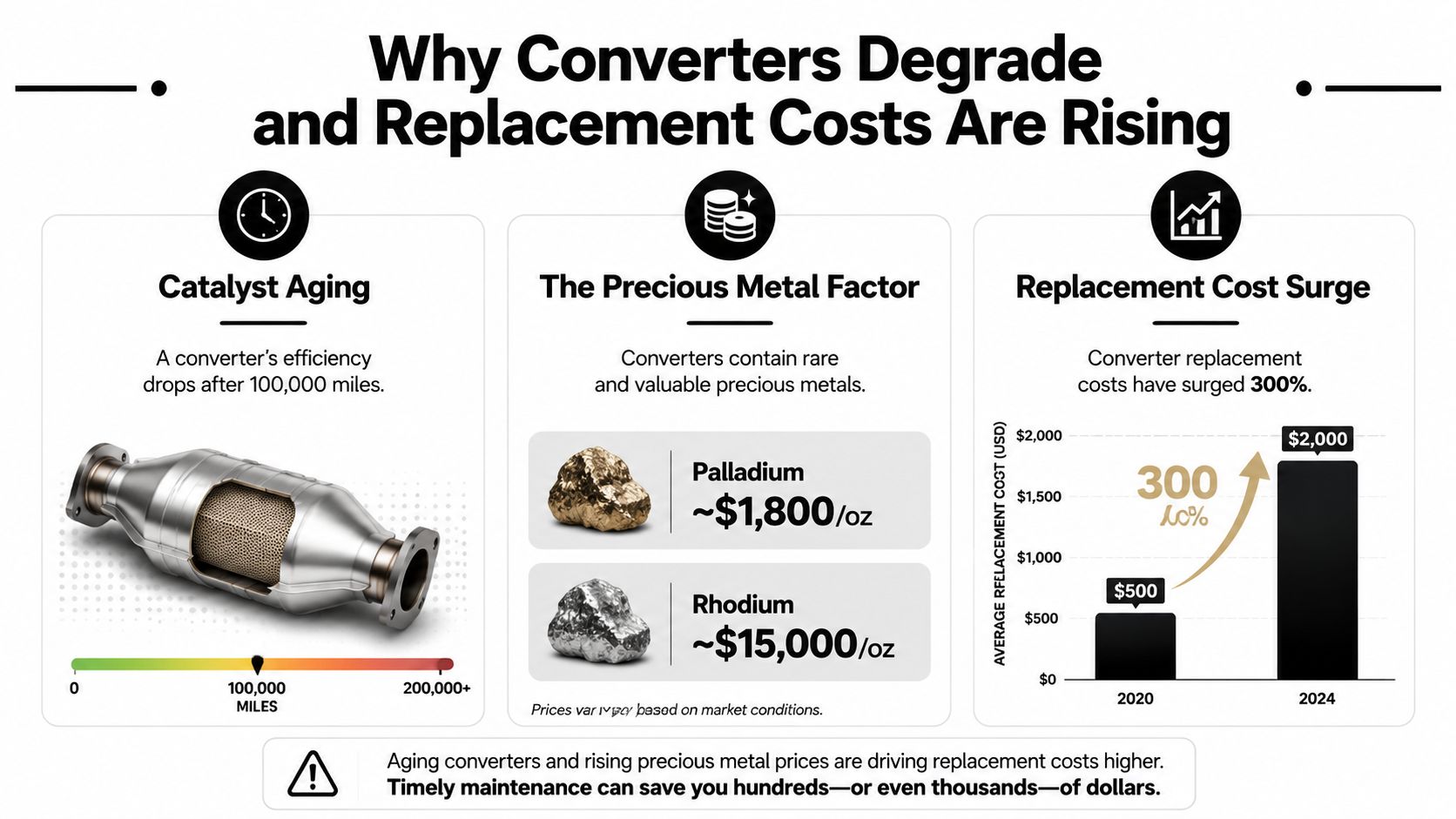
Catalysts age because they operate in a harsh environment. Exhaust heat, repeated mixture changes, contaminants, and physical vibration gradually reduce the converter's ability to store oxygen and promote reactions. As that chemical reserve weakens, the system has less margin when the engine briefly runs rich or lean.
SAE testing found that oxygen storage capacity fell by about a factor of two from 4,000 to 50,000 miles, then declined by another 30% from 50,000 to 150,000 miles. The same SAE technical paper on catalyst aging and sulfur effects reports that each 150 ppm increase in fuel sulfur reduced oxygen storage capacity by about 10%.
Aging changes the diagnostic picture
When oxygen storage becomes weaker, the converter can't smooth out rich and lean swings as effectively. Once the storage material becomes saturated under the wrong conditions, nitrogen-oxide reduction can stop, and oxidation of carbon monoxide and hydrocarbons during rich operation becomes less reliable.
That doesn't mean mileage alone condemns a converter. A well-maintained vehicle and a poorly maintained vehicle can age very differently because the catalyst's history matters. Repeated misfires, incorrect fueling, and contamination can expose the converter to conditions that accelerate damage.
For owners researching possible inspection failures, this guide to catalytic converter smog check failure reasons can provide additional diagnostic context.
Precious metals connect performance to replacement economics
Platinum, palladium, and rhodium perform different catalytic roles, and the exact metal mix varies by converter design, engine, emissions requirements, and manufacturer calibration. That means two converters that look similar from underneath may not provide identical emissions performance or replacement value.
Industry reporting on 2025 precious-metals markets describes palladium as up more than 15% year to date and platinum as up more than 10% in one market report, while rhodium remains expensive and unstable, as discussed in this 2025 platinum-group-metals market report. These market conditions can affect manufacturing, replacement economics, recycling interest, and theft risk.
Manufacturers and researchers are responding by exploring designs that use lower precious-metal loadings, including single-atom approaches. The aim is to preserve emissions control while reducing dependence on scarce and volatile materials, especially during cold starts when the catalyst has not yet reached efficient operating conditions.
A replacement decision should therefore consider more than the price of a metal canister. The correct part must match the vehicle's emissions requirements and operating system, and the underlying engine fault must be repaired first.
When a Converter Code Is Not Really a Converter Problem
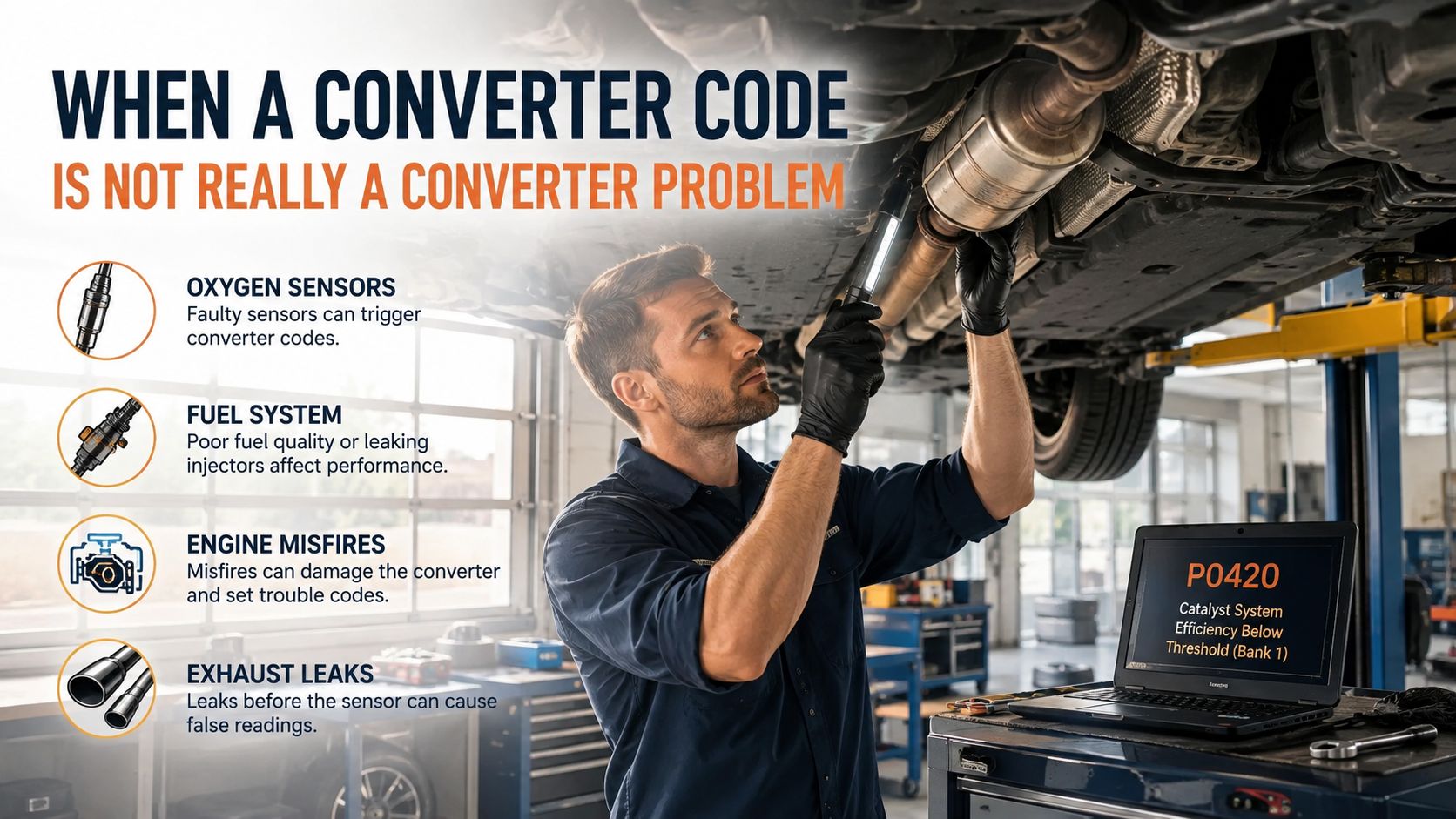
A P0420 or P0430 code can mean the converter isn't meeting the expected efficiency threshold. It doesn't automatically mean the catalyst has failed internally. Independent technical guidance emphasizes that converters work efficiently only when the engine operates properly and the exhaust system remains leak-free, which is why a converter code can be a symptom rather than the root cause.
Start upstream of the converter
A cylinder misfire sends unburned fuel into the exhaust. That fuel can burn inside the converter, raising temperatures and damaging the catalyst material. If the check engine light is flashing, continued driving can turn an engine-control problem into an expensive emissions-component problem.
A fuel-control fault creates a different pathway. If an injector leaks, fuel pressure is incorrect, or an airflow measurement is wrong, the engine may deliver a mixture outside the converter's effective operating window. The converter may still be physically intact, but it can't clean exhaust correctly when the incoming chemistry is continually wrong.
An exhaust leak can mislead the sensors in another way. Outside air entering near the manifold or before a sensor adds oxygen to the exhaust stream, causing sensor readings that don't represent what left the cylinders.
Use a decision sequence instead of a parts cannon
Before approving converter replacement, a technician should work through the conditions that can produce the code:
- Check misfire data: Look for current, pending, or stored misfire information and address ignition, injector, compression, or timing concerns.
- Inspect fuel control: Review oxygen-sensor and fuel-trim behavior for evidence of a persistent rich or lean condition.
- Test for exhaust leaks: Inspect the manifold, gaskets, flex pipe, welds, and sensor fittings for leaks that can introduce outside air.
- Confirm sensor operation: Compare upstream and downstream sensor behavior rather than replacing a sensor solely because a converter code is present.
- Evaluate converter condition: Only after the supporting systems pass inspection should the catalyst itself become the primary suspect.
For owners who want a basic explanation of stored and pending faults, this guide to reading OBD diagnostic codes is a useful starting point.
Vehicles from 2000 and newer can still fail smog checks when upstream misfires, fuel-control problems, or exhaust leaks keep the catalyst from reaching or maintaining proper operating conditions, as noted in this technical guidance on converter diagnosis and evolving catalyst designs. The sensible question isn't “How quickly can I replace the converter?” It's “What caused the emissions system to report low efficiency?”
What This Means for Your Smog Check and Vehicle Maintenance
A smog check examines more than whether the car feels normal on the road. For many modern vehicles, the inspection includes the onboard diagnostic system, emissions readiness information, sensor-related data, and a visual review of emissions equipment and the exhaust system.
The practical preparation is straightforward, but timing matters. Clearing a check engine light immediately before testing can erase readiness information, leaving the vehicle not ready for inspection even if the light stays off.
Prepare the vehicle before the appointment
Use this checklist as a starting point:
- Keep the check engine light off: Diagnose the reason for any active warning instead of disconnecting the battery or clearing codes.
- Complete the required drive pattern: After repairs or battery loss, drive the vehicle through the conditions needed for its readiness monitors to set.
- Repair misfires first: Ignition faults and fueling problems can damage the converter and cause an emissions failure.
- Check the exhaust for leaks: Small leaks can alter oxygen-sensor readings and undermine the test result.
- Bring repair information: If a technician has already diagnosed a fault, provide the codes and completed work so the inspection team has useful context.
Technicians also watch for obvious converter or exhaust damage during the visual portion of an inspection. A missing, modified, damaged, or visibly leaking emissions component can create a problem even when the car's computer has no active converter code.
Habits that protect the catalyst
The converter depends on the engine, so maintenance that keeps combustion stable protects the exhaust system too. Use the fuel specified for the vehicle, avoid questionable additives, and repair rough running promptly. Prolonged idling, repeated short trips, and unresolved warning lights can keep the converter from operating under favorable conditions.
A converter that becomes restricted may produce sluggish acceleration, unusual heat, or rattling from a damaged substrate. Those symptoms require mechanical diagnosis because similar complaints can also come from ignition, fuel, transmission, or exhaust problems.
For a broader preparation list, review these common smog check failure reasons before scheduling the inspection.
Testing time depends on the vehicle and the inspection requirements. At a properly equipped station, tests for 2000 and newer vehicles typically take about 10 to 15 minutes, according to Speedy Smog's service information. Older vehicles, diesels, and hybrids may require additional inspection steps or different procedures.
Key Takeaways for East Bay Drivers
The converter's job is chemical, not mechanical filtering. It uses a coated substrate and precious-metal catalysts to reduce hydrocarbons, carbon monoxide, and nitrogen oxides, while oxygen storage helps the system handle ordinary changes in engine mixture.
Three practical lessons matter most:
- Engine condition comes first: A converter needs properly controlled exhaust and a leak-free system.
- A converter code needs context: P0420 or P0430 can result from misfires, fuel-control faults, sensor problems, or exhaust leaks.
- Maintenance protects the expensive parts: Promptly repairing rough running and warning lights gives the catalyst a better chance of lasting.
A smog check is also a diagnostic opportunity. Instead of treating an emissions failure as a parts-shopping exercise, ask the technician to verify readiness status, inspect the exhaust, review sensor behavior, and identify whether the converter is failing or reacting to an upstream fault.
If your check engine light is on or your California registration renewal requires testing, schedule an inspection with a STAR Certified station that can evaluate the emissions system accurately. Speedy Smog in San Leandro offers smog testing for most vehicles, including newer cars, older vehicles, diesels, and hybrids, with a convenient location at 15275 Washington Ave and Monday-through-Saturday hours.
Visit Speedy Smog in San Leandro for a STAR Certified smog check and practical emissions guidance. If a catalytic converter code appears, ask the team to help determine whether the catalyst itself has failed or whether an upstream engine or exhaust problem is causing the reading.