Smog Check Stations: A Guide for California Drivers 2026
You open your DMV renewal notice, see that you need a smog check, and immediately have questions. Where do you go, how long will it take, what does it cost, and what happens if your car doesn't pass?
That's normal. A lot of first-time drivers think smog check stations work like repair shops, or that the process will take half the day. In California, it's usually much simpler than that. Once you know what the station does, what type of station you need, and how the appointment works, the whole thing feels a lot more manageable.
Table of Contents
- What Are Smog Check Stations and Why Do You Need One
- STAR Certified vs Regular Smog Check Stations Explained
- Your Smog Check Appointment What to Expect
- Common Smog Check Failures and How to Avoid Them
- How to Choose the Right Smog Station for You
- Get Your Smog Check Done Fast at Speedy Smog
What Are Smog Check Stations and Why Do You Need One
A smog check station is a place where your vehicle's emissions system gets inspected for California registration compliance. The easiest way to think about it is this: it's a routine checkup for the parts of your car that affect what comes out of the tailpipe and how the emissions system is working.
California uses smog checks to help keep vehicles within state emissions rules. For many drivers, this comes up during registration renewal. If your notice says a smog check is required, the state wants proof that the car passed before registration can be completed.
Why the process feels fast
Many people expect a long mechanical inspection, but that's usually not what happens at smog check stations. Geotab's California smog check guide says a typical smog check takes about 20 to 30 minutes per vehicle and is usually required every two years, and Diamond Certified notes that many California vehicles need testing every other year once they are more than four years old.
That short appointment time shaped how these stations operate. They're built for consistent, repeatable inspections, not for all-day repair work.
A smog check station is usually a compliance stop first, not a full diagnostic shop.
When drivers usually need one
You'll most often deal with a smog check when:
- Your DMV renewal notice requires it: This is the most common reason.
- Your vehicle falls into the regular testing cycle: Many California vehicles are tested every other year once they're older than the initial exempt period.
- You need proof of compliance: Passing the test allows the certificate to be used for registration.
Here's where people get tripped up. They assume every car gets tested the same way, every time. In reality, the station follows California rules for your vehicle type and model year, and the inspection is standardized around that.
What the station is really doing
A technician isn't judging whether your whole car is “good” or “bad.” They're checking whether it meets emissions-related requirements under the state's system. That's why a car can run fine and still have a smog issue, or feel rough but still pass if the emissions system is working properly.
If you're going in for the first time, the main thing to know is simple. A smog check is a normal part of owning a vehicle in California. It's usually quick, it follows a set process, and once you understand that, it stops feeling mysterious.
STAR Certified vs Regular Smog Check Stations Explained
One of the most confusing parts of the process is the word STAR. Drivers see it on the DMV notice or on shop signs and wonder if it's optional, more expensive, or only for problem cars.
The simple answer is that both regular and STAR smog check stations are licensed, but STAR stations are held to a stricter performance standard.
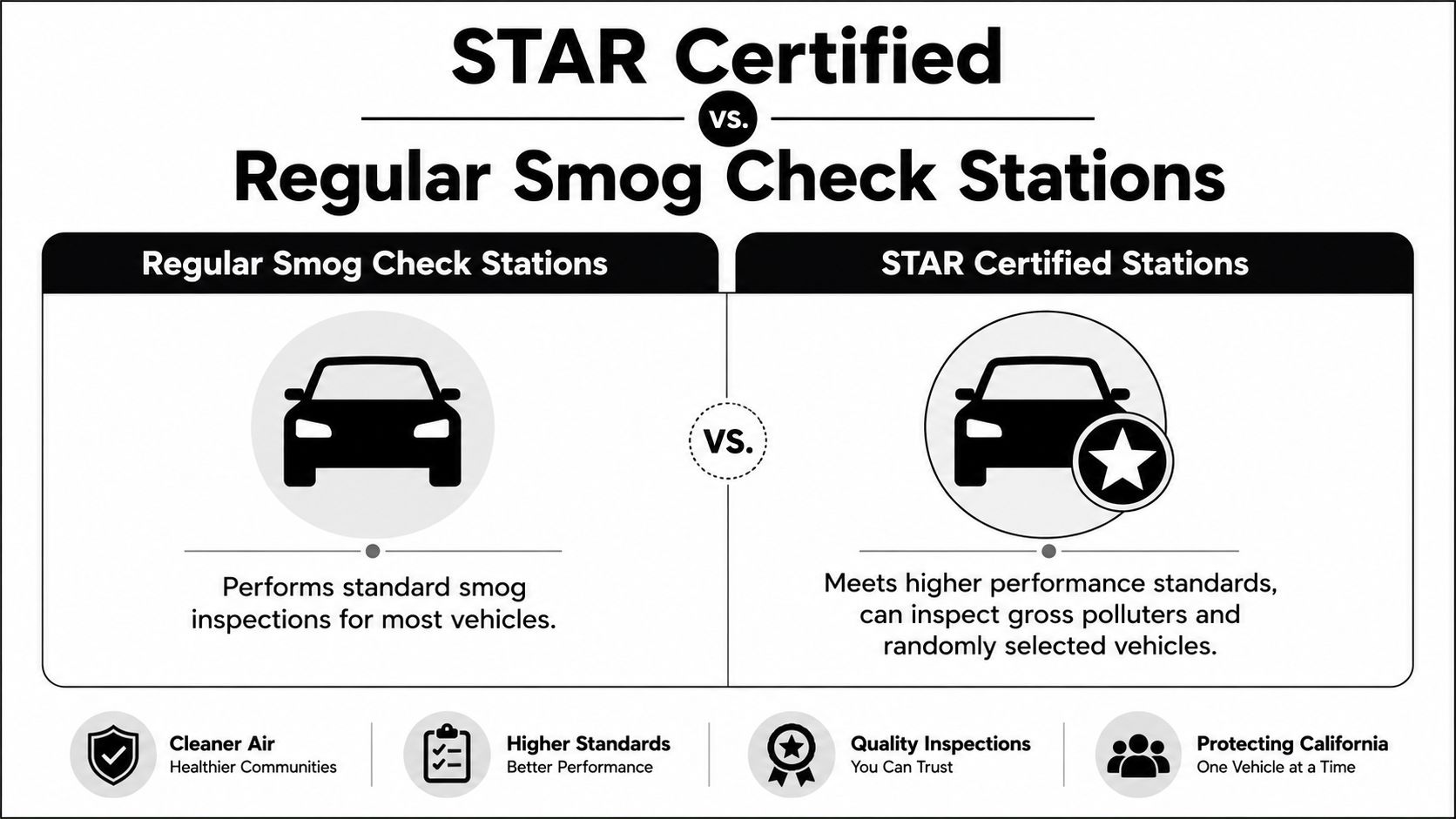
Regular stations and STAR stations side by side
| Station type | What it means for you |
|---|---|
| Regular smog check station | Handles standard inspections for many vehicles |
| STAR certified station | A higher-compliance subset of licensed stations intended for higher-risk vehicles and closer oversight |
According to this explanation of STAR vs regular smog checks in California, STAR smog check stations are intended to test higher-risk vehicles with greater rigor.
Why the DMV may require STAR
Some vehicles are directed to a STAR station because the state wants that inspection handled under tighter oversight. That doesn't mean you did anything wrong. It also doesn't automatically mean your vehicle is failing. It just means the vehicle falls into a category where California wants a more closely monitored inspection.
That's why your renewal paperwork matters. If it says STAR, don't waste time going to a regular station first.
Practical rule: If your DMV notice says STAR, go straight to a STAR-certified station. It saves a second trip.
Why some drivers choose STAR even when they don't have to
A STAR station can also be a smart choice for drivers who aren't specifically required to use one. The same California STAR guidance notes that choosing a STAR-certified station can reduce the risk of a repeat visit caused by a borderline result or a station that lacks the required oversight level for certain vehicles.
That matters if your car is older, has had emissions work in the past, or you just want the inspection done under the highest compliance standard available for this type of test.
A regular station isn't “bad,” and a STAR station isn't magic. The difference is oversight, consistency, and suitability for vehicles that need that extra layer of scrutiny. If you're unsure which type you need, checking the DMV notice first is the quickest way to avoid confusion.
Your Smog Check Appointment What to Expect
The appointment itself is usually straightforward. Most of the stress comes from not knowing the order of events. Once you've seen it once, it feels routine.
Start by bringing the basics you're likely to need, such as your DMV notice and a payment method. If you've never been to a smog check station before, it also helps to arrive a few minutes early so you're not rushing.
Here's a simple visual walkthrough of the visit:
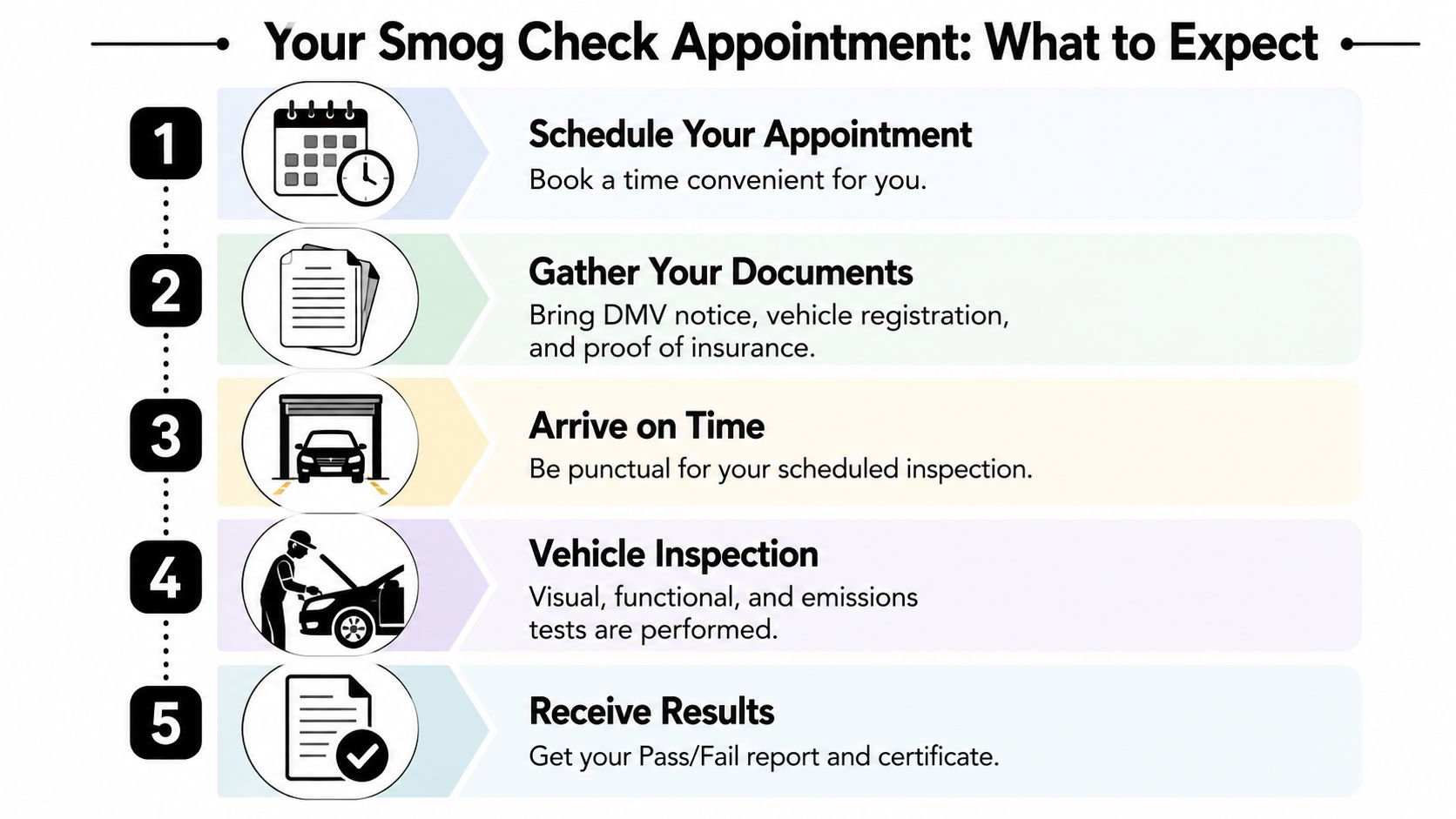
What happens after you pull in
A technician checks your vehicle information and starts the inspection under California's testing rules. Depending on the vehicle, that can include emissions-related checks tied to the car's system and required inspection procedure.
You don't need to coach the technician or explain how the car runs unless there's something unusual they need to know. For most drivers, the easiest move is to hand over the paperwork, answer questions clearly, and let the process happen in order.
How pricing usually works
This part confuses a lot of people because there are really two charges involved. The station sets its own inspection price, but the state certificate fee is separate.
The Diamond Certified California smog FAQ says the Bureau of Automotive Repair requires stations to post inspection prices, and consumer guidance cited there says drivers should typically expect to pay about $29.95 to $59.95 plus tax and the fixed $8.25 state certificate fee.
That means two nearby smog check stations might charge differently for the inspection itself, while the certificate fee stays the same.
Look at the posted pricing before the test starts. You should be able to see the inspection price and understand what's separate from the state fee.
A quick pricing snapshot looks like this:
| Cost part | Who sets it |
|---|---|
| Inspection price | The smog station |
| Certificate-of-compliance fee | The state, fixed at $8.25 |
What happens at the end
If the vehicle passes, the certificate is handled through the state process so your DMV registration can move forward. If it doesn't pass, you'll get paperwork showing the result, and that gives you a starting point for repairs.
For a quick visual explanation of how the visit works, this short video helps first-timers see the flow before they arrive.
The key thing to remember is that the appointment isn't supposed to feel dramatic. It's a set procedure with posted pricing, a pass-or-fail result, and a clear next step either way.
Common Smog Check Failures and How to Avoid Them
Most failed smog checks come down to a small number of issues. Some are obvious, like a warning light on the dash. Others are the kind of thing drivers ignore because the car still seems to run fine.
The good news is that you can lower the odds of a surprise by doing a little prep before the appointment.
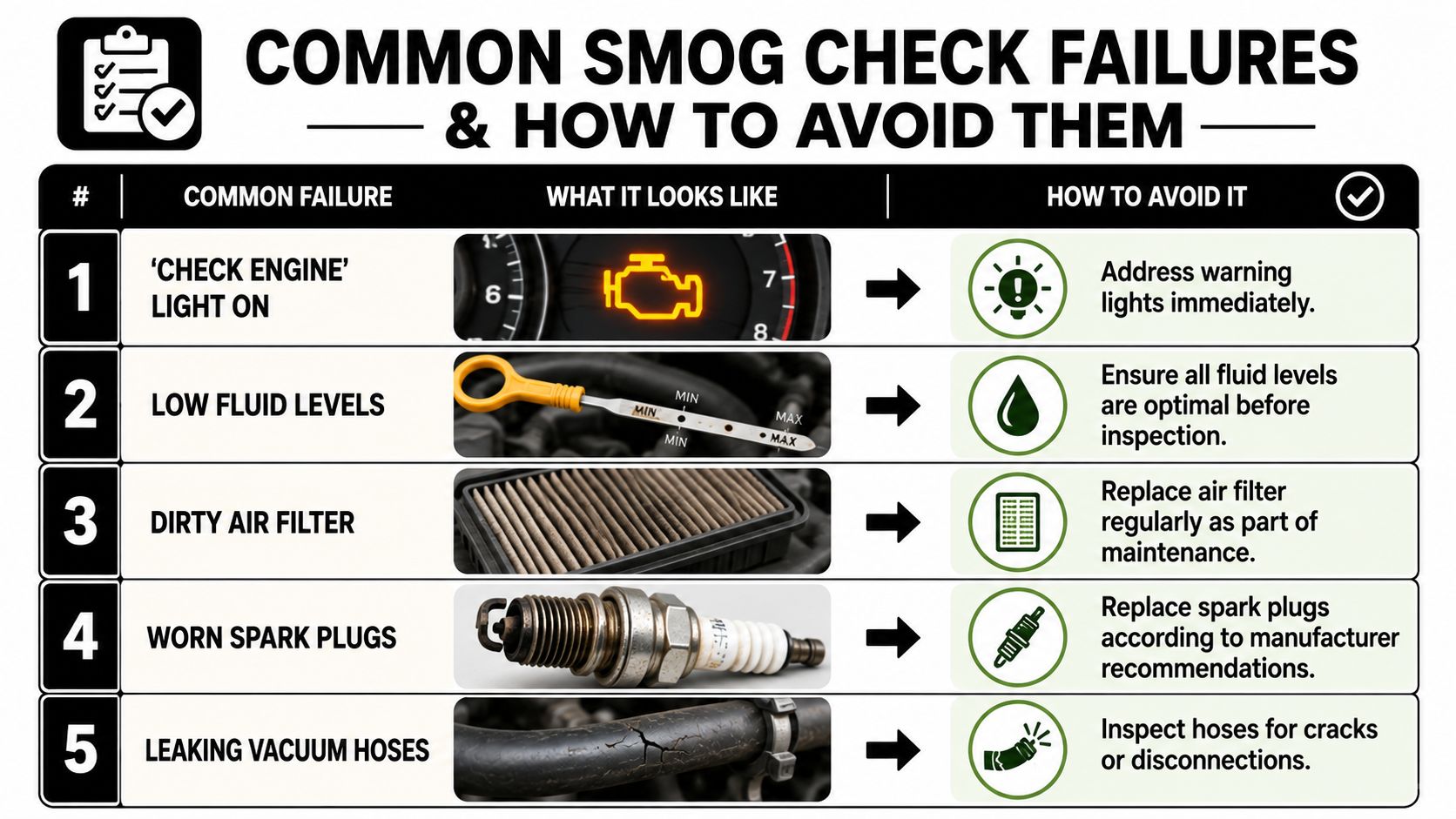
Problems that catch drivers off guard
These are common trouble spots to think about before you head in:
- Check engine light on: If that light is illuminated, don't assume it's minor. Even if the car feels normal, emissions-related faults can trigger a failure.
- Loose gas cap or sealing issue: A cap that isn't tight or isn't sealing correctly can create emissions-system problems.
- Recently disconnected battery: If battery power was interrupted, the car may need normal driving time before its systems are ready again.
- Neglected basic maintenance: Dirty filters, worn spark plugs, or vacuum-related issues can affect how cleanly the engine runs.
- Visible problems under the hood: Hoses, leaks, or obvious missing emissions-related parts can create inspection trouble.
Simple things you can do before the test
You don't need to be a mechanic to improve your odds. A few simple checks help:
- Drive the car before the appointment. Don't bring it in cold if you can avoid it.
- Make sure the gas cap is snug. It sounds small because it is, but small issues matter here.
- Handle warning lights first. Don't pay for a test if you already know something is wrong.
- Stay current on maintenance. A car that's overdue for tune-up basics is more likely to cause problems.
- Don't clear codes right before a test. If a problem was recently reset instead of repaired, the car may not be ready.
If your dashboard is warning you about something, treat that as the first job. The smog check comes after that.
If your car doesn't pass
A failed test isn't the end of the story. It means the station found an emissions-related issue that needs attention before the vehicle can complete the process.
Bring the failure paperwork to a qualified repair shop and have the underlying problem diagnosed. Don't guess, and don't throw random parts at the car. One accurate repair is usually cheaper and less frustrating than several hopeful ones.
A calm approach works best here. Read the report, fix the actual issue, and then return for the next step. That's much easier than treating a failure like a disaster.
How to Choose the Right Smog Station for You
You pull out your renewal notice, look up a nearby smog shop, and then wonder, “How do I know if this is the right place?” That question trips up a lot of California drivers, especially the first time. Choosing a station is less about finding any shop with a smog sign and more about finding one that fits your car, your paperwork, and your day.
A good smog station should make the process feel simple.
Start with the part California cares about first. Your station has to match your vehicle's requirement. If your DMV paperwork says STAR, you need a STAR Certified station. If it does not, you may have more options. Either way, checking this before you leave home saves you from the most frustrating kind of delay: showing up at the wrong place and having to start over.
After that, look at how the shop runs.
A smog check is a short visit, but a disorganized station can make it feel much longer. The best choice usually has:
- Clear pricing: You should know the fee before the test starts.
- A convenient location: A nearby shop is easier to fit into work, school pickup, or errands.
- An organized check-in process: Walk-ins and appointments should both feel easy to understand.
- A decent waiting setup: Even a quick stop is less stressful when the space is clean and straightforward.
Reviews can help, but use them as a final check, not the first one. A friendly review does not fix the wrong certification or confusing pricing. Start with the basics, then see whether other local drivers describe the experience as quick, clear, and professional.
For East Bay drivers, Speedy Smog in San Leandro is a useful example of what to look for in a local station. Based on the business information provided for this article, it is STAR Certified and serves a wide range of vehicles, including newer models, older cars, diesels, and hybrids. That tells you what matters most in real life: the station meets California requirements and is set up to handle the kinds of vehicles East Bay drivers bring in.
The goal is not to find the fanciest shop. It is to find one that removes uncertainty. The right station tells you what it does, what it charges, and whether it can inspect your car before you waste time in line.
Get Your Smog Check Done Fast at Speedy Smog
If you live in San Leandro, Oakland, or elsewhere in the East Bay, the easiest smog check is usually the one that fits your day without turning into a project. That means a station with the right certification, a quick workflow, and staff who keep things moving.
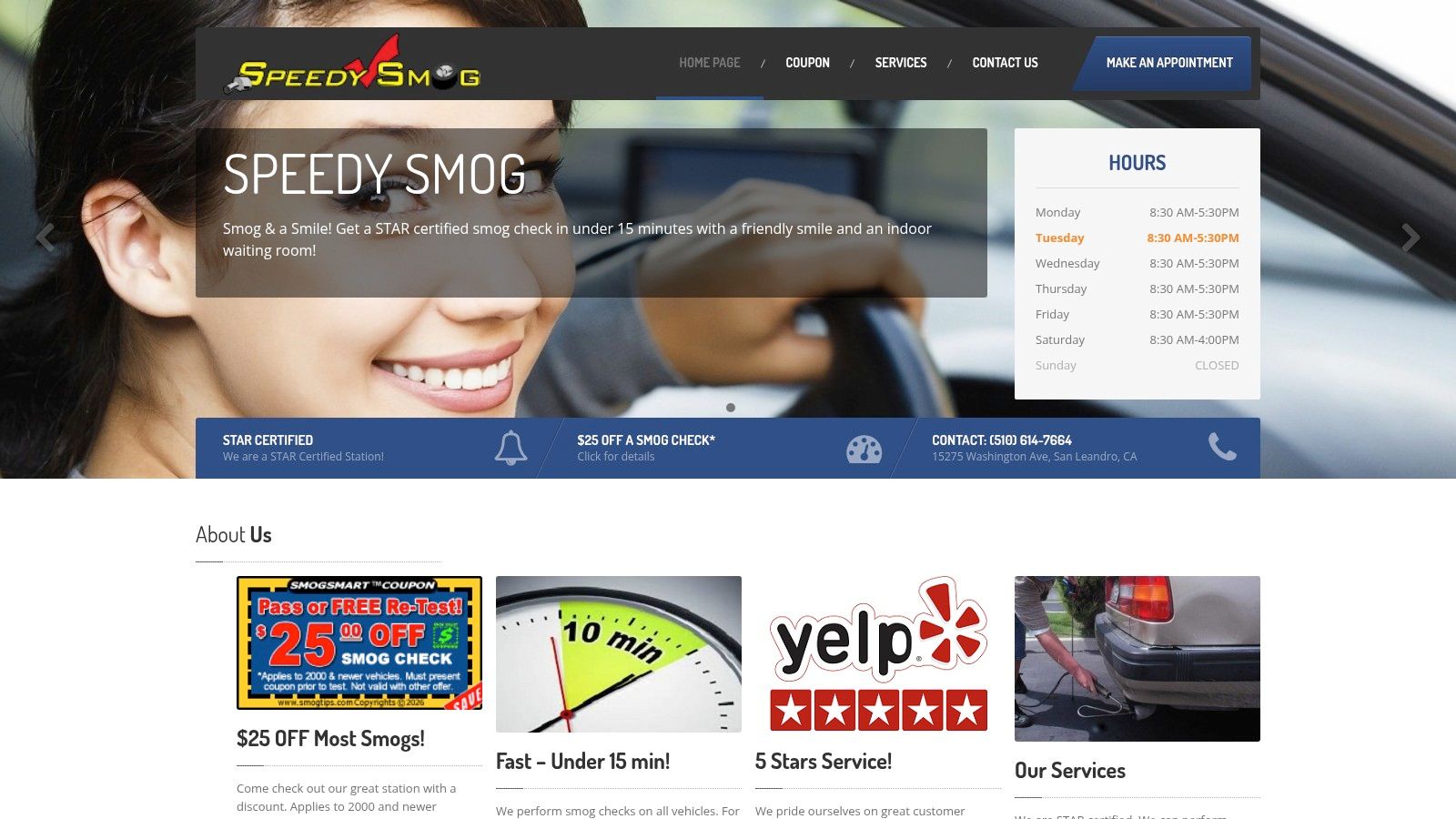
According to the publisher information provided for this article, Speedy Smog is located at 15275 Washington Ave, San Leandro, CA 94579, is STAR Certified, and handles inspections for 2000 and newer models, 1999 and older vehicles, diesels, and hybrids. The same business information says most tests for 2000+ vehicles are completed in about 10 to 15 minutes, and that the shop offers a clean indoor waiting room, transparent pricing, and periodic $25-off coupons for most smogs on newer vehicles.
Why that setup works for busy drivers
A station like this fits the problems people have with smog checks:
- You need the right station type: STAR certification covers that requirement.
- You don't want a long interruption: Short inspection times help.
- You want the price to be understandable: Transparent pricing makes that easier.
- You need basic comfort while waiting: A clean indoor space matters more than people expect.
The simple takeaway
Smog checks in California aren't complicated once you know the system. You check your DMV notice, confirm whether you need a regular or STAR station, show up prepared, and let the station run the inspection. If the car passes, you move on with registration. If it doesn't, you repair the issue and return with a clear direction.
That's the whole job. No mystery, no need to overthink it.
If you're due for a California emissions inspection in the East Bay, Speedy Smog is a practical place to start. You can check location details, hours, and current offers, then book the smog check that fits your schedule.